⚡
Quick Overview & Key Takeaways
Focus Topic:How to make Journal Entries in Accounting - Explanation
Estimated Reading Time:5 mins
- Comprehensive academic guide covering core concepts of How to make Journal Entries in Accounting - Explanation.
- Syllabus-aligned study material with detailed definitions, formats, and practical examples.
- Interactive check: Includes a custom practice quiz at the bottom of the article to self-evaluate knowledge.
Journal Entries in Accounting are the process of analyzing and recording business transactions in chronological (day to day) order. In this book, all transactions are recorded and it is known as Journal Daybook. It is also called the Book of Prime or Original Entry book. The journal entries are the foundation of the accounting system and it is also the first step of the accounting cycle.
Definition of Journal: -
“The process of recording a transaction in a journal is called journalizing the transactions.”
---Meigs and Meigs and Johnson
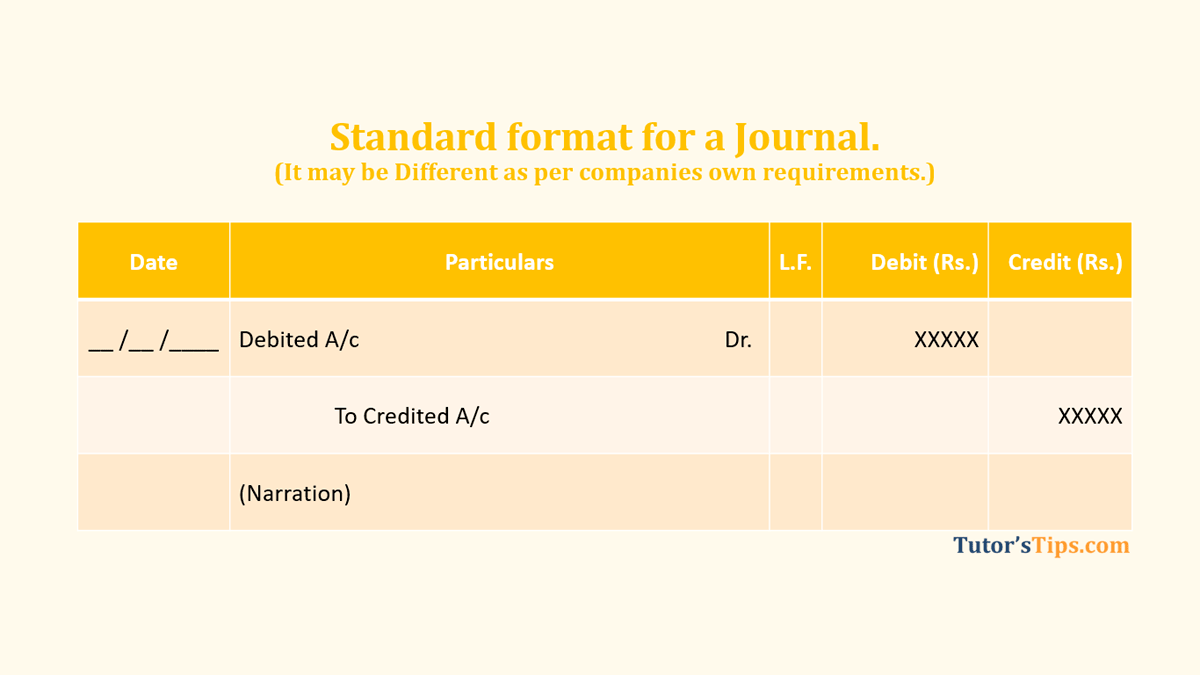
The standard format for Journal Entries in Accounting:-

Journal-Entry-Format[/caption]
Explanation of all column of the format of journal entries: -
1. Date column:-
In the Date column, we have to enter the date of the transaction. Like: Owner start the business with Rs. 5,00,000/- on 21/02/2018. So, we have to enter the 21/02/2018 in the date column.
2. Particulars:
In the particulars column, We have to write three things.
- Debit Accounts: - Name of all accounts which will be debited in the transaction
- Credit Accounts: - Name of all account which will be Credited in the transaction
- Narration: - Description of the transaction in short for future reference.
3. Ledger Folio:
In the Ledger Folio column, We have to note the page number of the Ledger where the transaction is posted in the ledger
4. Debit Amount:
In the Debit Amount Column, We have to enter the amount related to debit account individually in the transaction.
5. Credit Amount:
In the Credit Amount Column, We have to enter the amount related to Credit account individually in the transaction.
Rules of Debit and Credit:
In Journal we record all day to day Financial transaction of business. We have to record these with some standard rules/principle of accounting, With the help of rules, we know that which of the item/account will be
credited or debited. these are explained in following topics you can check these out from the following links.
https://tutorstips.com/golden-rules-of-accounting/
https://tutorstips.com/modern-approach-of-accounting/
Examples for the Journal Entries:-
Here, We will explain it With the following Examples of the Journal Entries. We have treated all the examples with
golden rules of accounting. you can use
modern rules of accounting.
Example No. 1: -
Date 01/02/2018: Purchase Furniture for Rs. 10,000/-
Solution:-
First, get the affected account. we have highlighted them with
red colour.
Date 01/02/2018: Purchase
Furniture for Rs.
10,000/-
| Select affected Accounts from the transaction |
Select the nature of Account |
Select Rule which will be Applied on these accounts |
Affect of a transaction on these accounts |
The condition of Rule applied |
According to Rule, get know which account will be Dr./Cr. |
| Cash -> |
Assets -> |
Real Account -> |
Cash paid for the purchase of asset -> |
Goes out |
Credit |
| Furniture -> |
Assets -> |
Real Account -> |
Furniture purchased so, It Comes In the business -> |
Comes In |
Debit |
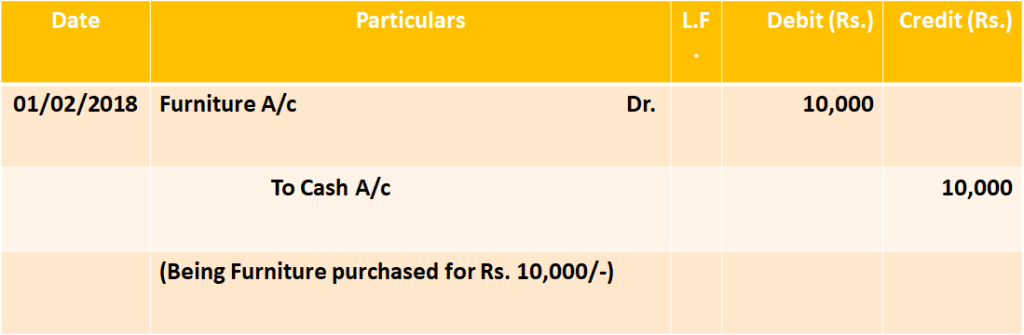
We are having a Debit account name = Furniture Account
and Credit account name = Cash Account
So, We will put it into the format of Journal Entries shown as the following: -

Journal-Entry-Example-No-1
Example No. 2: -
Date 05/02/2018: Purchase
Furniture for Rs. 10,000/- From
Aman on Credit
Solution:
Date 05/02/2018: Purchase
Furniture for Rs. 10,000/- From
Aman on Credit
| Select affected Accounts from the transaction |
Select the nature of Account |
Select Rule which will be Applied on these accounts |
Affect of a transaction on these accounts |
The condition of Rule applied |
According to Rule, get know which account will be Dr./Cr. |
| Aman-> |
Person -> |
Personal Account -> |
Aman supplied furniture -> |
Giver |
Credit |
| Furniture -> |
Assets -> |
Real Account -> |
Furniture purchased so, It Comes In the business -> |
Comes In |
Debit |
We are having a Debit account name = Furniture Account
and Credit account name = Aman Account
So, We will put it into the format of Journal shown as the following: -
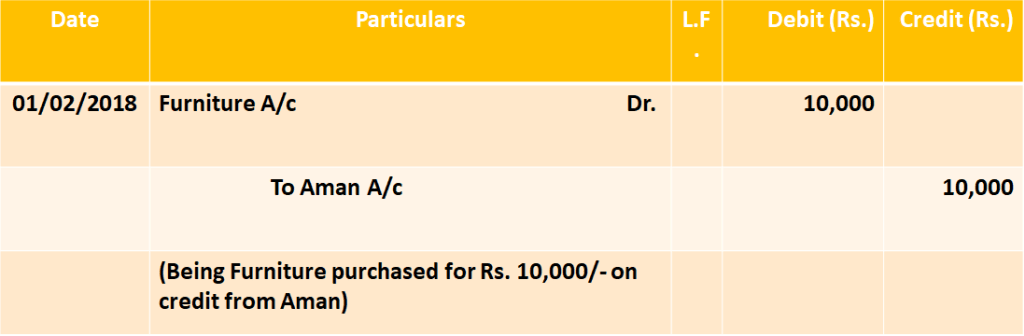
Journal-Entries-Example-No.2
Example No. 3: -
Date 05/02/2018: Salary paid to Employees Rs 5000/-
Solution: -
Date 05/02/2018:
Salary paid to Employees
Rs 5000/-
| Select affected Accounts from the transaction |
Select the nature of Account |
Select Rule which will be Applied on these accounts |
Affect of a transaction on these accounts |
The condition of Rule applied |
According to Rule, get know which account will be Dr./Cr. |
| Cash -> |
Assets -> |
Real Account -> |
Cash paid for salary -> |
Goes out |
Credit |
| Salary-> |
Expenses-> |
Nominal Account -> |
Expenses for the business -> |
All Expenses |
Debit |
We are having a Debit account name = Salary Account
and Credit account name = Cash Account
So, We will put it into the format of Journal shown as the following: -
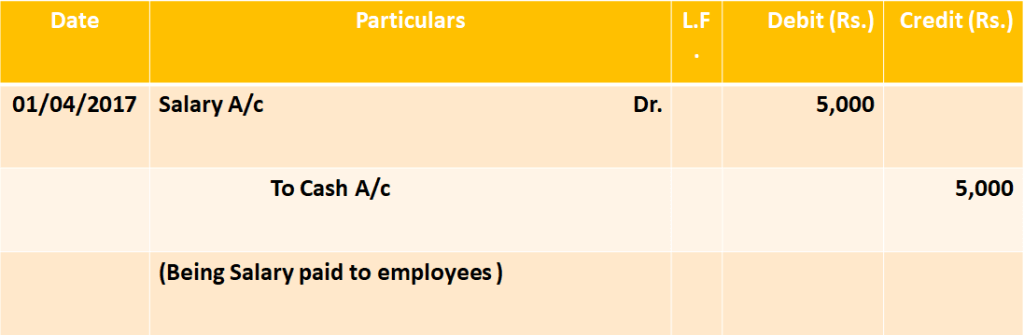
Journal-Entries-Example-No-3
Check out the Basic Journal Entries for the following: -
- Capital account
- Drawing
- Purchase of Goods/Inventories
- Sale of Goods
- Purchase of Assets
- Sale of Assets
- Expenses
- Incomes
Other Important Journal Entries: -
Thanks for reading the topic of Journal Entries,
please comment your feedback whatever you want in the comment box.