Loading Tutorstips...
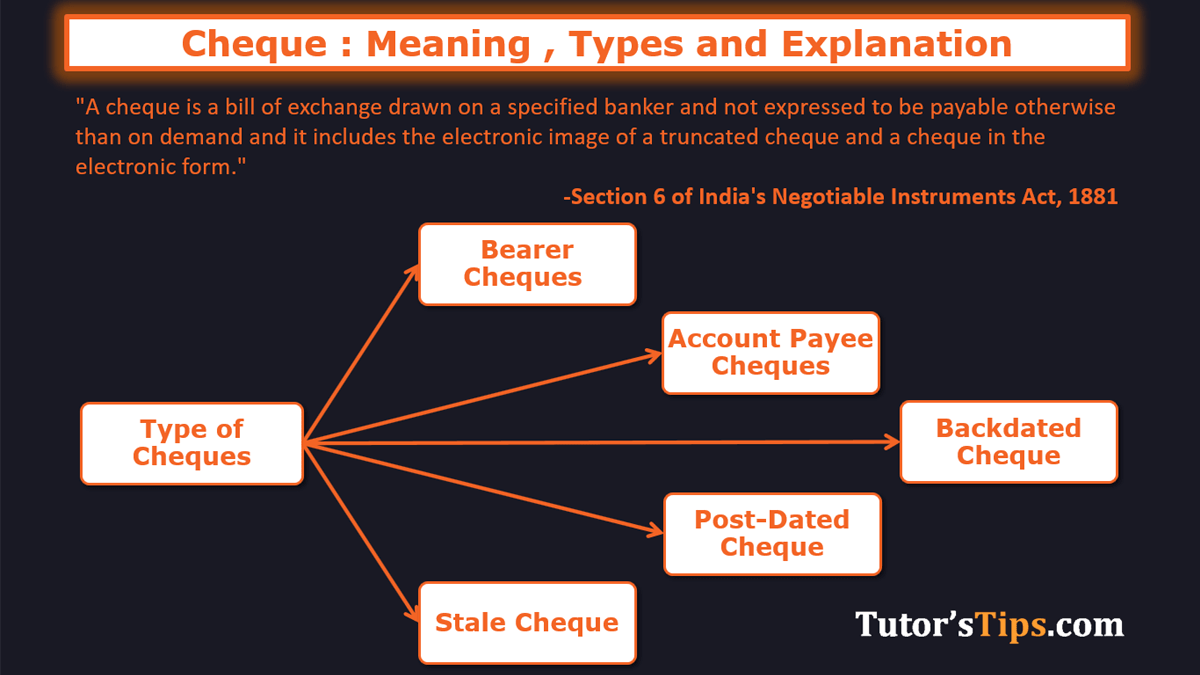
The cheque is an instrument in writing which contains an unconditional instruction to a banker (by a person who has already deposit the amount with a banker), to pay a specific amount to a certain person or to the order of the certain person or to the bearer of the instrument only on the demand.
The cheque is the most used type of negotiable instrument. It is simple and easy to use. It is the piece of paper on which the same of the payer is already mention and he will write the name of the receiver of the payment and amount to be paid and signed it. The receiver will receive cash from the cheque by encashing it from the bank.
"A cheque is a bill of exchange drawn on a specified banker and not expressed to be payable otherwise than on demand and it includes the electronic image of a truncated cheque and a cheque in the electronic form."
-Section 6 of India's Negotiable Instruments Act, 1881
The Content covered in this article: -
There are three parties are involved, shown as follows:-
The drawer is the person who issues the cheque to his/her creditor and holds a bank account. The purchase of goods and services is also known as a drawer (expect some cases).
The person who is directed to make payment of some specific/mentioned amount to the already mentioned person on it.
The drawee is the person who will receive the payment from the banker against the sale of goods and services and whose name is mention on it.
The format of all cheque almost the same with each other. It may vary from bank to bank like colour difference, size of cheques. The types of cheques are only changed at the time of issuing it to someone. The different type of cheques are shown as following: -
At the time of issuing a cheque if we did not cancel the word bearer on cheque then it will be known as bearer cheque. it can be encashed by any person from the bank counter. This type is very risky because when this type of cheques lost and who will found it, he can get cash against it from the bank.
At the time of issuing a cheque if the drawer marks two lines on the left side upper corner, centre at the top or right side upper corner of the cheque then it will be known as account payee cheque. it can be encashed by only in the account of that person whose name is mention on it. This is the safer way of issuing.
At the time of issuing the cheques if the drawer writes an earlier date form today on them then these are known as backdated cheques or anti dated cheques.
At the time of issuing the cheques if the drawer writes a next date form today on them then these are known as backdated cheques or post-dated cheques.
Those cheques which are expired without encashing it from the bank.
Thanks
Please share this topic with your friends.
Accounting & Commerce Educator
Sarbjit Singh holds a B.Com and M.Com degree and has over 12 years of teaching experience in double entry bookkeeping, financial accounting, and business studies.
The cheque is an instrument in writing which contains an unconditional instruction to a banker (by a person who has already deposit the amount with a banker),…
Class 11 and Class 12 commerce students, and CA Foundation aspirants, studying Financial Accounting.
Yes — this page includes a short interactive quiz so you can check your understanding straight away.
.jpg)


