
Question No 19 Chapter No 17 – Unimax Class 11
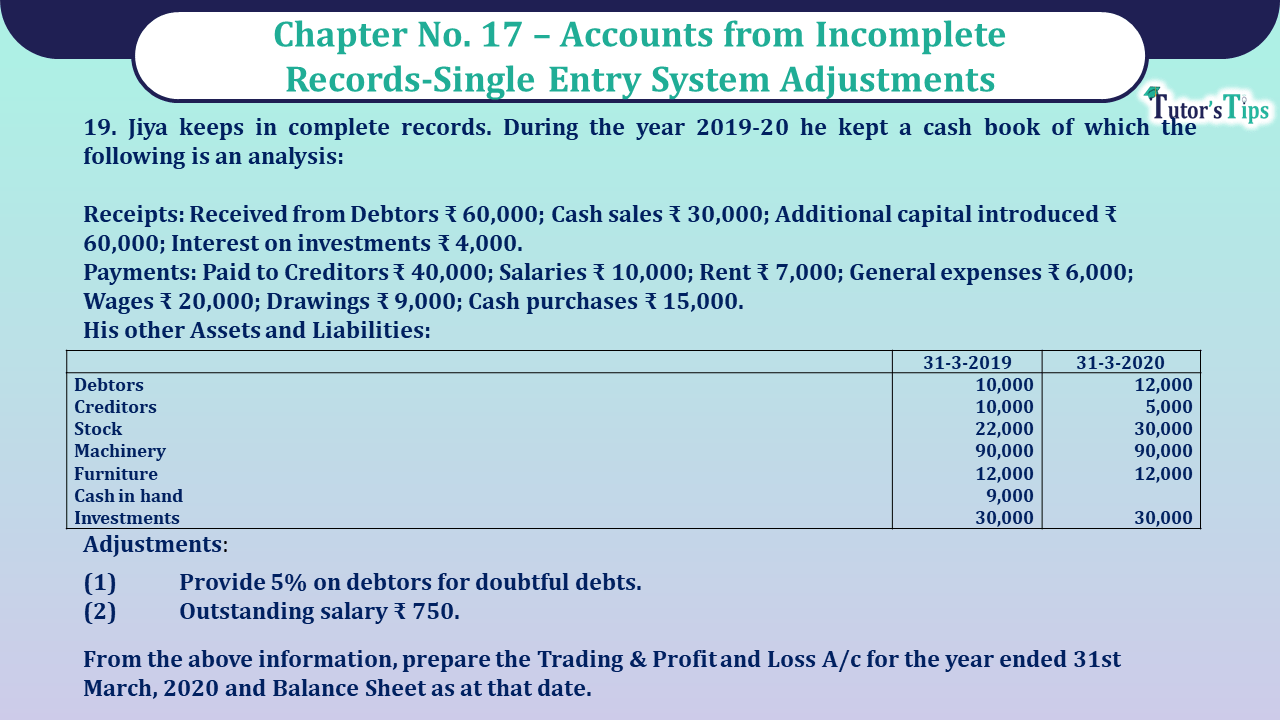
Jiya keeps in complete records. During the year 2019-20 he kept a cash book of which the following is an analysis:
Receipts: Received from Debtors ₹ 60,000; Cash sales ₹ 30,000; Additional capital introduced ₹ 60,000; Interest on investments ₹ 4,000.
Payments: Paid to Creditors ₹ 40,000; Salaries ₹ 10,000; Rent ₹ 7,000; General expenses ₹ 6,000; Wages ₹ 20,000; Drawings ₹ 9,000; Cash purchases ₹ 15,000.
His other Assets and Liabilities:
| 31-3-2019 | 31-3-2020 | |
| Debtors | 10,000 | 12,000 |
| Creditors | 10,000 | 5,000 |
| Stock | 22,000 | 30,000 |
| Machinery | 90,000 | 90,000 |
| Furniture | 12,000 | 12,000 |
| Cash in hand | 9,000 | |
| Investments | 30,000 | 30,000 |
Adjustments:
(1) Provide 5% on debtors for doubtful debts.
(2) Outstanding salary ₹ 750.
From the above information, prepare the Trading & Profit and Loss A/c for the year ended 31st March, 2020 and Balance Sheet as at that date.
The solution of Question No 19 Chapter No 17 – UNIMAX Class 11
Cash book
| Receipts | Amount | Payments | Amount |
| To Balance b/d (1-4-2019) | 9,000 | By Payments to Creditors | 40,000 |
| To Receipts from debtors | 60,000 | By Salaries | 10,000 |
| To Cash sales | 30,000 | By Rent | 7,000 |
| To Additional capital | 60,000 | By General expenses | 6,000 |
| To Interest on Investments | 4,000 | By Wages | 20,000 |
| By Drawings | 9,000 | ||
| By Cash Purchases | 15,000 | ||
| By Balance c/d (balance figure on 31-3-2020) | 56,000 | ||
| 1,63,000 | 1,63,000 |
Total Debtors A/c
| Particulars | Amount | Particulars | Amount |
| To Balance b/d (1-4-2019) | 10,000 | By cash received from debtors | 60,000 |
| To Credit sales (Balance figure) | 62,000 | By Balance c/d (31-3-2020) | 12,000 |
| 72,000 | 72,000 |
Total Creditors A/c
| Particulars | Amount | Particulars | Amount |
| To Cash paid to creditors | 40,000 | By Balance b/d (1-4-2019) | 10,000 |
| To Balance c/d (31-3-2020) | 5,0000 | To Creditors purchases (Balance figure) | 35,000 |
| 45,000 | 45,000 |
Opening Balance Sheet
As at 1st April 2019
| Liabilities | Amount | Assets | Amount |
| Creditors | 10,000 | Cash in hand | 9,000 |
| Capital (Balance figure) | 1,63,000 | Debtors | 10,000 |
| Stock | 22,000 | ||
| Investments | 30,000 | ||
| Furniture | 12,000 | ||
| Machinery | 90,000 | ||
| 1,73,000 | 1,73,000 |
Trading and Profit and Loss A/c
For the year ending 31st March, 2020
| Particulars |
Amount | Particulars |
Amount | ||
| To Opening stock | 22,000 | By Sales: | |||
| To Purchases: | Cash sales | 30,000 | |||
| Cash purchases | 15,000 | Credit sales | 62,000 | 92,000 | |
| Credit purchases | 35,000 | 50,000 | By Closing stock | 30,000 | |
| To Wages | 20,000 | ||||
| To Gross Profit c/d | 30,000 | ||||
| 1,22,000 | 1,22,000 | ||||
| To Salaries | 10,000 | By Gross Profit B/d | 30,000 | ||
| Add: Outstanding | 750 | 10,750 | By Interest on Investments | 4,000 | |
| To Rent | 7,000 | ||||
| To General expenses | 6,000 | ||||
| To Provision for doubtful debts | 600 | ||||
| To Net profit | 9,650 | ||||
| 34,000 | 34,000 | ||||
Balance Sheet
As at 31st March, 2020
| Liabilities | Amount | Assets | Amount | ||
| Creditors | 5,000 | Cash in hand | 56,000 | ||
| Outstanding salary | 750 | Debtors | 12,000 | ||
| Capital | 1,63,000 | Less: provision for doubtful debts | 600 | 11,400 | |
| Add: Additional capital | 60,000 | Stock | 30,000 | ||
| Add: Net Profit | 9,650 | Investments | 30,000 | ||
| Less: Drawing | 9,000 | 2,23,650 | Furniture | 12,000 | |
| Machinery | 90,000 | ||||
| 2,29,400 | 2,29,400 | ||||
Thanks, Please Like and share with your friends
Comment if you have any Doubts.
Final Accounts: Meaning, Definition and Explanation
Profit and Loss Account: Meaning, Format & Examples
Balance Sheet: Meaning, Format & Examples
Also, Check out the solved question of all Chapters: –
Advanced Accountancy – Unimax Class 11 – 2021 – Solution.
Part-I
- Chapter No. 1 – Introduction of Accounting
- Chapter No. 2 – Theory Base of Accounting
- Chapter No. 3 – Vouchers and Transactions
- Chapter No. 4 – Journal
- Chapter No. 5 – Goods and Services Tax (GST): An Introduction
- Chapter No. 6 – Ledger
- Chapter No. 7 – Special Purpose Book – Cash Book
- Chapter No. 8 – Other Subsidiary Books
- Chapter No. 9 – Trial Balance
- Chapter No. 10 – Rectification of Errors
- Chapter No. 11 – Depreciation
- Chapter No. 12 – Provision and Reserves
- Chapter No. 13 – Bank Reconciliation Statement
- Chapter No. 14 – Bills of Exchange
Students may choose only one part from the Part II and Part III
Part-II
- Chapter No. 15 – Financial Statements (Without Adjustments)
- Chapter No. 16 – Financial Statements (With Adjustments)
- Chapter No. 17 – Accounts from Incomplete Records – Single Entry System
Part-III
- Chapter No. 18 – Introduction to Computers and Accounting information System
- Chapter No. 19 – Computerised Accounting
- Chapter No. 20 – Accounting Software: Tally
- Chapter No. 21 – Data Base System
- Chapter No. 22 – Concept of Entity and Relationship
Usha Publication – Elements of Book-Keeping PSEB (Class 11) – Solution
Chapter No. 2 – Theory Base of Accounting
Chapter No. 3 – Origin of Transactions
Chapter No. 4 – Vouchers and transactions
Chapter No. 6 – Accounting for Goods and Services Tax(GST)
Chapter No. 9 – Other Subsidiary Books
Chapter No. 10 – Journal Proper
Chapter No. 11 – Trial Balance
Chapter No. 12 – Bank Reconciliation Statement
Chapter No. 14 – Provisions and Reserves
Chapter No. 15 – Bills of Exchange
Chapter No. 16 – Rectification of Errors
Chapter No. 17 – Financial Statements – (Without Adjustments)
Chapter No. 18 – Financial Statements – (With Adjustments)
Check out T.S. Grewal +1 Book 2019 @ Oficial Website of Sultan Chand Publication4