Loading Tutorstips...
Deprecation is a very simple and scoring chapter for all class 11 students. It is just a conceptual chapter. SO are you ready to learn more new concepts? Let's start.
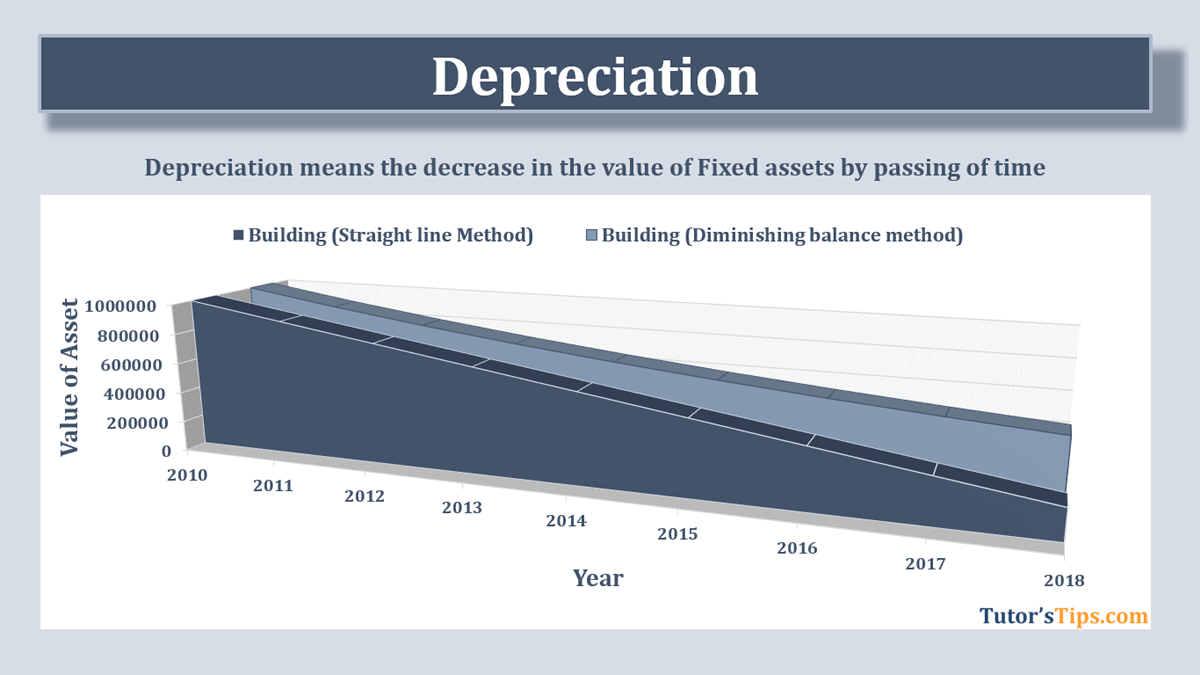
Depreciation means the decrease in the value of Fixed assets by passing time. It is charged only on fixed assets (except Land) Because every fixed asset has a life of more than one year but will not last indefinitely and The land has an indefinitely life so it will be appreciated. Depreciation is treated as indirect expenses of the business and transferred to the income statement of the company and profit/loss account of the business.
There are three types of decreases in the value of an asset, which refers to a different category of fixed assets shown as follows.
1. Depreciation is used for the Tangible fixed asset. Such as Building, Plant, Machinery, Furniture, fixtures, vehicles, Computers, etc.
2. Depletion is used in referring to the physical exhaustion of natural resources. Such as oil wells, Coal mines, etc.
3. Amortization is used for the Intangible fixed asset. Such as Goodwill, Patents, trademarks, leaseholds, etc.
We will explain this topic with help of the following points :
We can treat Depreciation in two ways as follows:
1. When the net book value of assets is shown on the Balance sheet after deducting an amount of depreciation from the opening book value of an asset.
Example:
Depreciation charged on building @ 10% on Rs 10,00,000/-.
Solution: -
We will treat two account
Date Depreciation A/c Dr. 1,00,000
To Building A/c 1,00,000
(Being Dep charge on the building)
"After that, at the end of the year, we will transfer all income and expenses to Profit and loss account or income statement to get the actual profit or loss of the business for this we post this following transaction."
2. Depreciation transferred to Profit and Loss account or income statement
Date Profit and Loss A/c Dr. 1,00,000
To Depreciation A/c 1,00,000
(Being amount of dep transferred to Profit or loss account)
Note: If you did not know how to apply this rules of accounting please check this link
https://tutorstips.com/golden-rules-of-accounting
2. When the original book value of assets shown on the Balance sheet and Accumulated depreciation/Provision for depreciation account opened and shown on the liability side of the balance sheet.
Example: Depreciation charged on building @ 10% on Rs 10,00,000/-.
Solution: -will treat two account
The account of Provision has a credit balance so it will be shown on the liability side of the Balance Sheet.
Date Depreciation A/c Dr. 1,00,000
To Provision for Dep on Building A/c 1,00,000
(Being Dep charged and provision account opened )
Date Profit and Loss A/c Dr. 1,00,000
To Depreciation A/c 1,00,000
(Being Depreciation transferred to Profit and Loss account or income statement)
1. Straight Line Method(Get more Explanation by click on it) |
In this method, we calculate a fixed amount of depreciation on the original cost of an asset and charge until the book value of an asset will equal to zero or its scrap value. This method is also called the original cost method and fixed cost method. |
2. Diminishing Balance Method(Get more Explanation by click on it) |
We calculate the depreciation under this on the closing value of an asset and charge until the book value of an asset will equal its scrap value. It is also called the written down value and reducing value method. |
3. Annuity Method(Get more Explanation by click on it) |
In this method, we calculate a fixed amount of depreciation on the original cost of an asset but also calculate interest on the invested amount of capital on the purchase of this asset with help of an annuity table. |
4. Sinking Fund Method(Get more Explanation by click on it) |
This method will provide us with depreciation as well as provide funds for the replacement of this asset when an asset need replacement like the end of life of an asset. Under this method, we charged depreciation on the value of the asset but will not be credited to the asset account instead we will credit to the sinking fund account. This account will be shown on the liabilities side of the Balance Sheet(Because it is a funds account) and an asset will be shown on the original value on the assets side of the Balance Sheet. At the end of each accounting year, the total amount of sinking fund credited in a year will be invested in the outside marketable security to provide cash for the replacement of an asset when needed. |
5. Insurance Policy Method(Get more Explanation by click on it) |
In this method, An endowment policy is taken from an insurance company for an amount that is sufficient for the replacement of an asset. It is similar to the sinking fund method only difference is we take insurance instead of an investment. The term insurance policy will equal the life of an asset. |
6. Sum of Digits Method(Get more Explanation by click on it) |
The sum of the digits method is formed due to the decrease in the productivity of an asset with the passage of time. It means that an asset has a more useful life in the earlier year. So, that's why we have to charge depreciation more in the earlier year as compared with the subsequent year of life of an asset. It is slightly similar to the written down value method. In written down value the amount of depreciation will continue to decrease every year in this method also. |
7. Revaluation Method(Get more Explanation by click on it) |
Where we did not know the accurate life of an asset or where the life of an asset is uncertain and depreciation cannot be calculated with any other method then we will revalue an asset at the end of the financial year when the balance sheet prepared, So if any decrease in the book of an asset will be treated as the amount of dep. or if any increase then it will be ignored. |
8. Machine Hour Rate Method(Get more Explanation by click on it) |
This method is applicable to those assets on which we record their life in hours like Plant and Machine. So we have to keep the record of the total working hour of a machine consumed in a single financial year and the total amount of working hours consumed within the financial year is depreciation for that financial year. We will calculate depreciation by firstly calculate Machine Hour Rate then we multiply it by the total working hours of the machine within a single financial year. |
9. Mileage or Kilometer Method(Get more Explanation by click on it) |
This method is very much similar to the Machine hour rate method. But it is applied to the vehicle instead of the machine. So the life of the vehicle can be measured into total kilometres that will be covered by it. Rate per mile or kilometres can we determine when the total cost of an asset divided by to kilometres it can run in its whole life. The amount of annual dep will be calculated by multiplying the total kilometres run during the financial year by the rate per kilometre. |
10. Depletion Method(Get more Explanation by click on it) |
It is used for wasting assets like coal, mines, well and etc. The rate of dep is calculated by dividing the cost of an asset by the estimated quantity of product likely to be available. The amount of the dep can be calculated when we multiplying the total output of the financial year with the rate of depreciation. |
Accounting & Commerce Educator
Sarbjit Singh holds a B.Com and M.Com degree and has over 12 years of teaching experience in double entry bookkeeping, financial accounting, and business studies.
Deprecation is a very simple and scoring chapter for all class 11 students. It is just a conceptual chapter. SO are you ready to learn more new concepts? Let's…
Class 11 and Class 12 commerce students, and CA Foundation aspirants, studying Financial Accounting.
Yes — this page includes a short interactive quiz so you can check your understanding straight away.
3 July 2020
4 July 2020
4 July 2020
26 August 2020
11 February 2021
25 December 2022
8 January 2023