Loading Tutorstips...
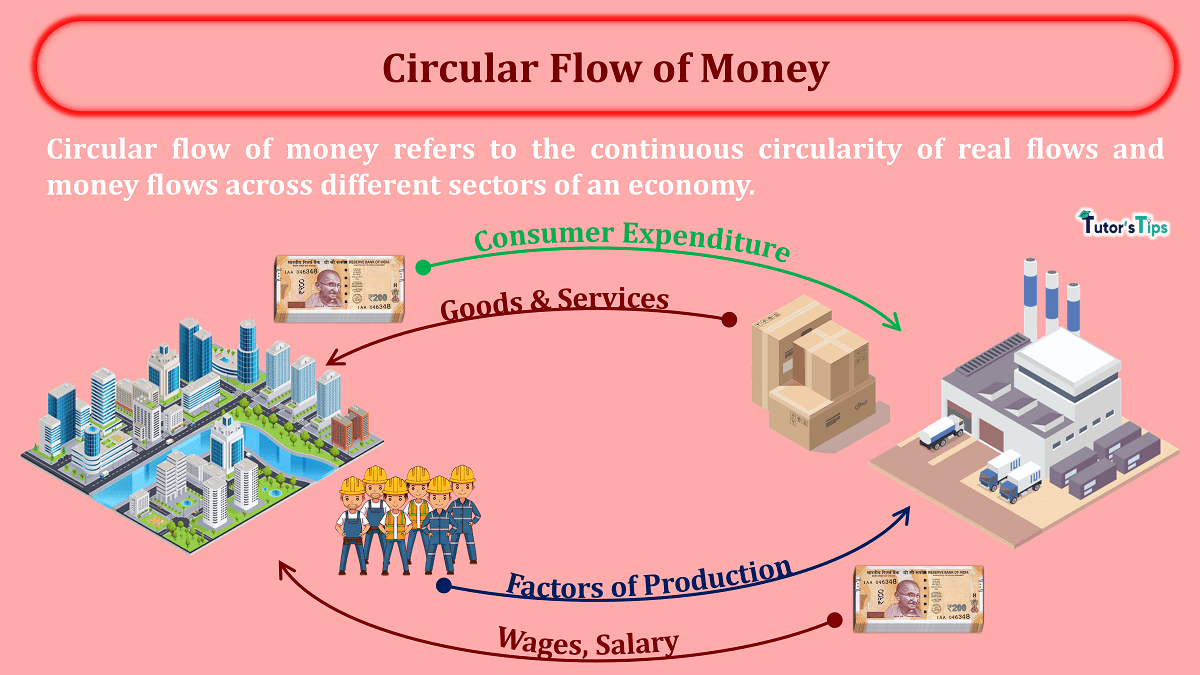
Circular flow of money refers to the continuous circularity of real flows and money flows across different sectors of an economy.
In an economy, the money flows from producers to households for the purchase of factor services is a continuous process. Similarly, the money flows from households to producers for the purchase of goods and services. It is a continuous process. This intersectoral flow never stops. Hence, it is known as "circular flow". This never stops, because:
In other words, the circular flow of money between the producer sector and household sector never stops. It is because the process of consumption never stops and the process of production never stops.
The understanding of the circular flow of money is important due to the following reasons:
This model helps to understand the interdependence among the different sector of the economy. In this, it is explained how the consumers are dependent on producers for the goods and services to meet the needs. Similarly, it also explains how producers are dependent on consumers for the supply of factor services.
This model facilitates the estimation of national income. For example, National income is the sum total of factor incomes flowing in the economy from producers to households. Here, the factor services include payments in form of rent, profit, wages and interest. Thus, it can be defined as the market value of goods and services flowing from producers to other sectors in the economy. Therefore, the circular flow of money is also known as the circular flow of income. Further, it may be defined as the sum total of the expenditures on the goods and services produced by the producer sector.
Economics Educator
Mrs. Dilgeerjot Kaur holds a B.Com and M.Com degree and has over 9 years of teaching experience in microeconomics, macroeconomics, and business economics.
Circular flow of money refers to the continuous circularity of real flows and money flows across different sectors of an economy. Circular flow of money: In an…
Class 11 and Class 12 commerce students, and CA Foundation aspirants, studying Economics Class 12.
Yes — this page includes a short interactive quiz so you can check your understanding straight away.