Loading Tutorstips...
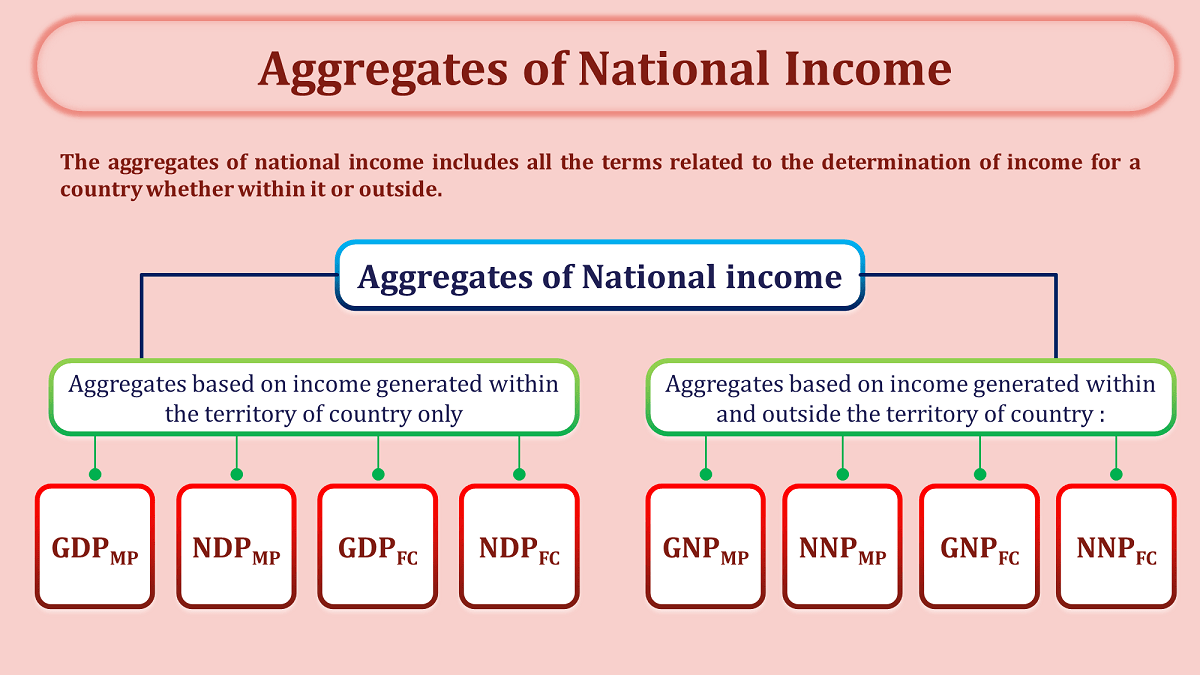
The aggregates of national income include all the terms related to the determination of income for a country whether within it or outside. It majorly includes GDPMP, NDPMP, GNPMP, NNPMP, GDPFC, NDPFC, GNPFC, and NNPFC.
The aggregates of national income can be classified based on the income generated within the country and outside. These are:
GDPMP can be defined as the market value of goods and services produced within the domestic territory of a country during an accounting year, inclusive of the depreciation or consumption of fixed capital.
Net domestic product at market price refers to the market value of goods and services produced within the domestic territory of a country during an accounting year, exclusive of the depreciation or consumption of fixed capital. Thus, it can be written as :
NDPMP = GDPMP - Depreciation
GDPFC can be defined as the sum total of the factor incomes including compensation of employees, rent, interest and profit generated within the domestic territory of a country during an accounting period including the depreciation. Thus, it can be calculated as:
GDPFC = Compensation of employees +rent + Interest + Profit + Depreciation (Consumption of fixed capital)
NDPFC can be defined as the sum total of the factor incomes including compensation of employees, rent, interest and profit generated within the domestic territory of a country during an accounting period excluding the depreciation. Hence, it can be written as:
NDPFC = Compensation of employees +rent + Interest + Profit
Gross national product at market price refers to the sum total of the market value of goods and services produced within the domestic territory of a country during an accounting year, exclusive of the depreciation or consumption of fixed capital and net factor income from abroad. In other words, it can be defined as the sum of gross domestic product at market price and net factor income from abroad. Thus, it can be written as:
GNPMP = GDPMP + NFIA
where,
NFIA refers to net factor income from abroad
Net national product at market price refers to the sum total of the market value of goods and services produced within the domestic territory of a country during an accounting year, exclusive of the depreciation or consumption of fixed capital and net factor income from abroad. In other words, it can be defined as the sum of net domestic product at market price and net factor income from abroad. Hence, it can be written as:
NNPMP = NDPMP + NFIA
where,
NFIA refers to net factor income from abroad
It refers to the sum total of factor incomes including compensation of employees, rent, interest and profit generated within the domestic territory of a country during an accounting period including the depreciation and net factor income from abroad. In simple words, it can be defined as the total gross domestic product at factor cost and net factor income from abroad. Hence,
GNPFC = GNPFC + NFIA
It refers to the sum total of factor incomes including compensation of employees, rent, interest and profit generated within the domestic territory of a country during an accounting period excluding the depreciation. and net factor income from abroad. In simple words, it can be defined as the total of net domestic product at factor cost and net factor income from abroad. Hence,
NNPFC = NDPFC + NFIA
The standard measure to identify the national income is with the net national product at factor cost. In other words, national income refers to the sum total of factor incomes earned by normal residents of a country during an accounting period against the factor services rendered. Thus,
National income = NNPFC
Or
National income = NDPFC + NFIA
Or
National income = Sum Total of factor incomes earned by normal residents of a country during an accounting period against the factor services rendered
Economics Educator
Mrs. Dilgeerjot Kaur holds a B.Com and M.Com degree and has over 9 years of teaching experience in microeconomics, macroeconomics, and business economics.
The aggregates of national income include all the terms related to the determination of income for a country whether within it or outside. It majorly includes…
Class 11 and Class 12 commerce students, and CA Foundation aspirants, studying Economics Class 12.
Yes — this page includes a short interactive quiz so you can check your understanding straight away.