Loading Tutorstips...

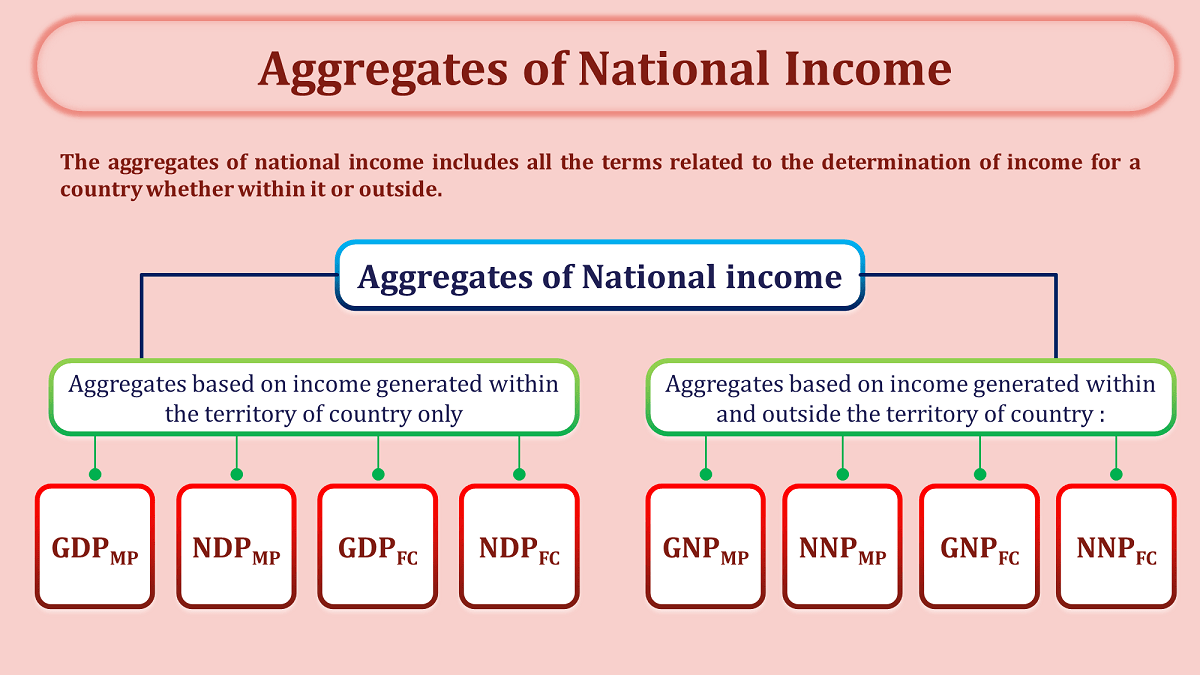
Domestic and national income is defined by domestic and national concepts in an economy. These terms define the income generated by residents or non-residents within or outside the domestic territory.
Domestic and National Income:
Domestic income is the total of factor incomes generated by residents as well as non-residents within a domestic territory of a country. In contrast, the national income is the sum of factor incomes earned within or outside the domestic territory by normal residents of a country only. To understand these concepts, the concept of domestic territory must be cleared.
In economics, the domestic territory is the geographical territory controlled by the government within which the persons, capital, and goods move freely. Thus, the domestic territory is a much wider concept than the political territory of any nation. In other words, the domestic territory of a nation includes:
Thus, domestic territory refers to the area of operation where persons, goods, and capital can circulate freely for economic interest. Hence, the factor incomes generated within domestic territory would be known as domestic income.
As we have discussed that the domestic income includes the factor incomes earned within the domestic territory of a country during a year. It includes the income of both residents as well as non-residents within the territory. Here, it is important to remember that domestic income :
Also, the difference between the above two is known as Net factor income from abroad. In other words,
Net income from abroad = factor income earned by residents in the domestic territory of any other nation - Factor income earned by non-residents in the domestic territory of a nation
Accordingly, the domestic income can be converted into national income when
Thus, we can say:
Domestic Income - factor income earned by non-residents in domestic territory + factor income earned by residents in rest of the world = National Income
Or
Domestic Income + Net Factor Income from abroad = National Income
On the other hand, for converting national income to domestic income, we will use:
National income - Net Factor Income from abroad = Domestic Income
Economics Educator
Mrs. Dilgeerjot Kaur holds a B.Com and M.Com degree and has over 9 years of teaching experience in microeconomics, macroeconomics, and business economics.
Domestic and national income is defined by domestic and national concepts in an economy. These terms define the income generated by residents or non-residents…
Class 11 and Class 12 commerce students, and CA Foundation aspirants, studying Economics Class 12.
Yes — this page includes a short interactive quiz so you can check your understanding straight away.