Loading Tutorstips...
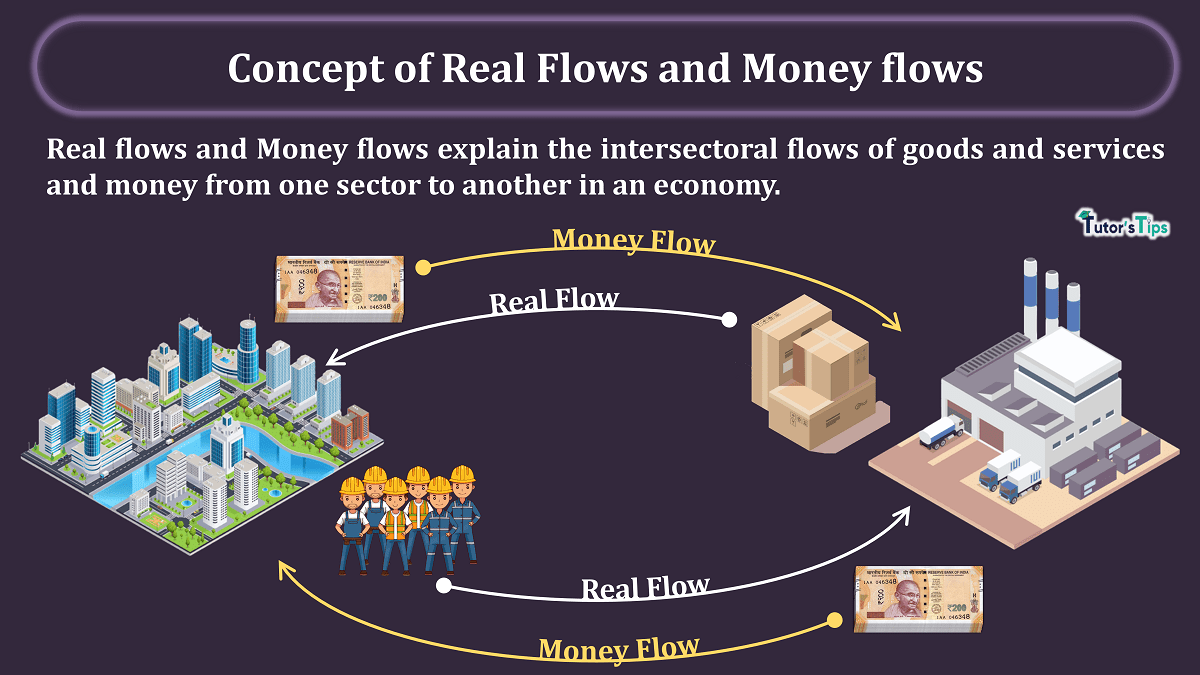
Real flows and Money flows explain the intersectoral flows of goods and services and money from one sector to another in an economy.
It refers to the flows driven by intersectoral dependence where goods and services or money is transferred from one sector to another. Intersectoral dependence defines how different sectors of an economy are dependent on each other. The following observations explain the intersectoral dependence:
Intersectoral flows can be classified as :
It refers to the flow of goods and services among different sectors of the economy. For example, the flow of factor services from households to the producer sector and the flow of goods and services from the producer sector to the household sector.
It refers to the flow of money among different sectors of the economy. For example, the flow of factor payments from the producer sector to the households and the flow of money to the producer sector by the household sector on account of purchase of goods and services.
In a barter system of exchange, where goods are exchanged for goods, there is only real flow in the economy. Workers provide their labor services on farms and fields. Thus, it is known as real flow. They received grains in return, which is also real flow. However, the barter system of exchange worked successfully only when human wants were limited. Thus, with the multiplicity of human wants, mutual interdependence also multiplied. Consequently, the barter system proved to be an inefficient system of exchange. As a result, the monetary system of exchange is introduced in which money is used as a medium of exchange. Thus, the money flows are the reciprocal of real flows in that economy.
The above figure shows the real flows in terms of goods and services sold by firms to households. And, the flow of factor services rendered by households to producers. Both these flows are real flows as they involve the movement of goods and services from one sector to the other. Money is not involved in this.
The above figure shows the money flows in terms of the flow of money from households to the producers for the purchase of goods. And, the flow of money from the producers to the households for the purchase of factor services. Each money flow is a reciprocal of the real flow. Thus, money flow from households to the producers is a reciprocal of the real flow of goods from producers to households. Similarly, money flow from producers to the households is a reciprocal of the real flow of factor services from the households to the producers.
Economics Educator
Mrs. Dilgeerjot Kaur holds a B.Com and M.Com degree and has over 9 years of teaching experience in microeconomics, macroeconomics, and business economics.
Real flows and Money flows explain the intersectoral flows of goods and services and money from one sector to another in an economy. Real Flows and Money Flows…
Class 11 and Class 12 commerce students, and CA Foundation aspirants, studying Economics Class 12.
Yes — this page includes a short interactive quiz so you can check your understanding straight away.