Loading Tutorstips...
Solvency Ratios show the capacity of the company to repay its long term liabilities by realising the total assets. It is also the basic ratio of the accounting ratios to know the companies financial position.
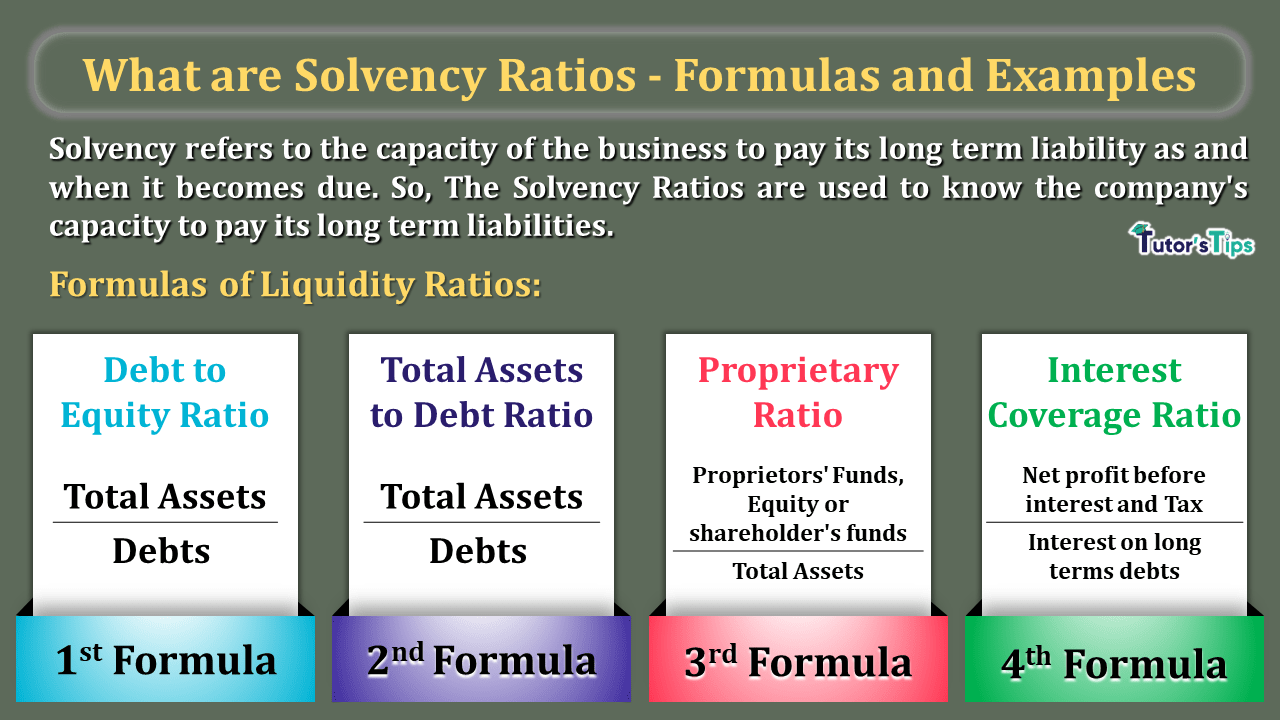
Solvency refers to the capacity of the business to pay its long term liability as and when it becomes due. So, The Solvency Ratios are used to know the company's capacity to pay its long term liabilities.
To pay the long term liabilities means paid the total due amount of long term liabilities by realising amount from the company's total assets.
Solvency ratio provides us with information about the financial stability of the business. The high Solvency ratio ensures that the company is in a good position to meet its long term financial obligation and the low Solvency ratio shows the low capacity of the firm to meet its long term financial obligation and it will lead to bankruptcy and fall down the credit rating of the business.
To Check out the liquidity of the business we can use the following three formulas:
The Debt to Equity ratio is used to compare the Equity (i.e. shareholder's funds) with debts (i.e. outsider's liabilities) of the business.
| Debt to Equity Ratio | = | Debts |
| Equity |
The Total Assets to Debt ratio is used to compare the Total assets with debts (i.e. outsider's liabilities) of the business.
| Total Assets to Debt Ratio | = | Total Assets |
| Debts |
The Proprietary ratio is used to compare the Proprietors' Funds, Equity or shareholder's funds with Total assets of the business.
| Proprietary Ratio | = | Proprietors' Funds, Equity or shareholder's funds |
| Total Assets |
The Interest Coverage ratio is used to compare the Net profit before interest and Tax with interest on long terms debts of the business.
| Interest Coverage Ratio | = | Net profit before interest and Tax |
| interest on long terms debts |
We will get ratio in times.
Thanks for reading the topic.
Accounting & Commerce Educator
Sarbjit Singh holds a B.Com and M.Com degree and has over 12 years of teaching experience in double entry bookkeeping, financial accounting, and business studies.
Solvency Ratios show the capacity of the company to repay its long term liabilities by realising the total assets. It is also the basic ratio of the accounting…
Class 11 and Class 12 commerce students, and CA Foundation aspirants, studying Advanced Financial Accounting.
Yes — this page includes a short interactive quiz so you can check your understanding straight away.