Loading Tutorstips...
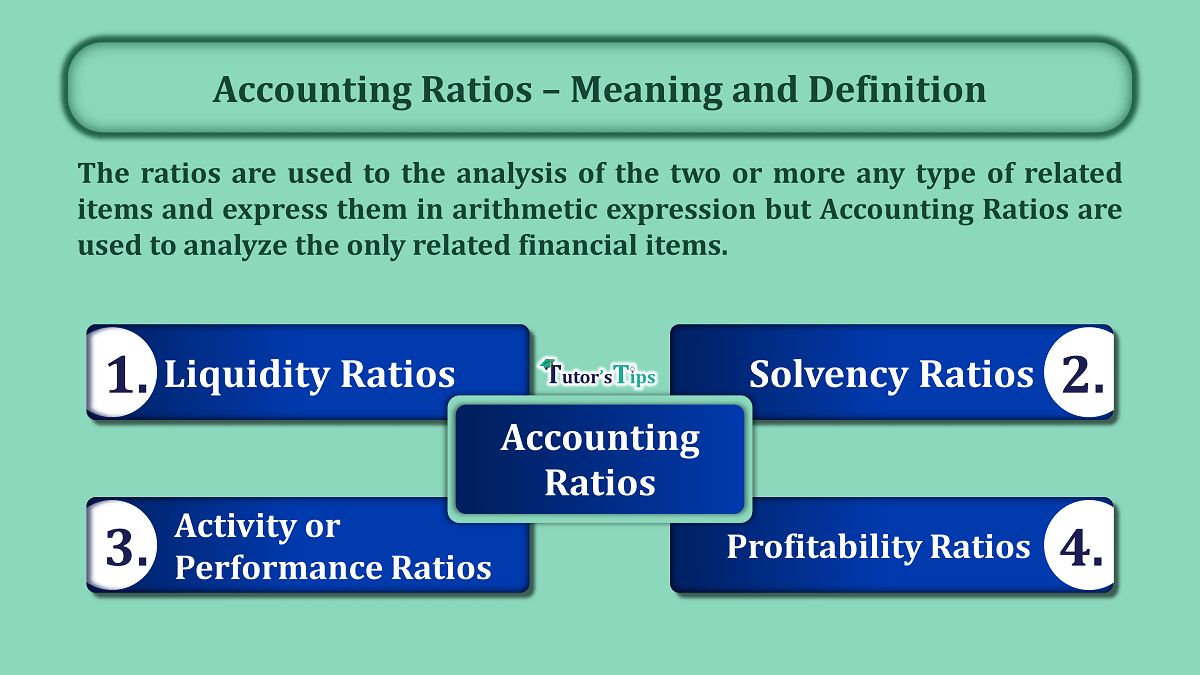
The ratios are used to the analysis of the two or more any type of related items and express them in arithmetic expression but Accounting Ratios are used to analyze the only related financial items.
"Accounting Ratios" is the sub-group of the ratio, These are used by accountants or other related parties to analyzing the interdependent Financial items of the financial statement of the business. Accounting ratios are used to know the profitability, efficiency and financial position of the company.
"The term accounting ratio is used to describe significant relationships which exist between figures shown in a Balance Sheet, in a Statement of Profit and Loss, In a budgetary control system or in any part of the accounting organisation."
- J. Betty
The Accounting Ratio can be classified into the four following types: -
Liquidity refers to the capacity of the business to pay its short term liability as and when it becomes due. So, The liquidity Ratios are used to know the company's capacity to pay its short term liabilities. The high liquidity ratio ensures that the company is in a good position to meet its financial obligation and vice versa.
To pay the short term liabilities means paid the total due amount of short term liabilities by realising amount from the company's short term assets.
The current ratio is used to compare the current assets with current liabilities of the business.
| Current Ratio | = | Current Assets |
| Current Liabilities |
The Quick or liquid Ratio is used to compare the Liquid assets with current liabilities of the business.
| Current Ratio | = | Liquid Assets |
| Current Liabilities |
The Absolute liquid or cash ratio is used to compare the Absolute liquid assets with current liabilities of the business.
| Current Ratio | = | Absolute liquid Assets |
| Current Liabilities |
Solvency refers to the capacity of the business to pay its long term liability as and when it becomes due. So, The Solvency Ratios are used to know the company's capacity to pay its long term liabilities.
To pay the long term liabilities means paid the total due amount of long term liabilities by realising amount from the company's total assets.
The Debt to Equity ratio is used to compare the Equity (i.e.shareholder's funds) with debts (i.e. outsider's liabilities) of the business.
| Debt to Equity Ratio | = | Debts |
| Equity |
The Total Assets to Debt ratio is used to compare the Total assets with debts (i.e. outsider's liabilities) of the business.
| Total Assets to Debt Ratio | = | Total Assets |
| Debts |
The Proprietary ratio is used to compare the Proprietors' Funds, Equity or shareholder's funds with Total assets of the business.
| Proprietary Ratio | = | Proprietors' Funds, Equity or shareholder's funds |
| Total Assets |
The Interest Coverage ratio is used to compare the Net profit before interest and Tax with interest on long terms debts of the business.
| Interest Coverage Ratio | = | Net profit before interest and Tax |
| interest on long terms debts |
We will get ratio in times.
Activity ratio is used to check out the way of the usage of resources of the enterprises. It gets to know to related parties the actual performance of the business. It is also known as performance or turnover ratio.
The Inventory Turnover Ratio is used to know the relationship between the cost of goods sold and average inventory carries during the year of the business.
| Inventory Turnover Ratio | = | Cost of goods sold (cost of Revenue from Operation) |
| Average Inventory |
Now the question is how to calculate the cost of goods sold:
Total Revenue from an operation - Gross Profit
or
Total Revenue from an operation + Gross Loss
Or
Opening Inventory + Net Purchase + Direct Expenses - Closing Inventory
Now, the question is how to calculate the Average Inventory:
| Opening Inventory | + | Closing Inventory |
| 2 | ||
2. Trade Receivable Turnover Ratio:
The Inventory Turnover Ratio is used to know the relationship between the Net Credit Sales and Average Trade Receivables.
| Trade Receivable Turnover Ratio | = | Net Credit Revenue from Operations |
| Average Trade Receivables |
Now the question is how to calculate the Net Credit Revenue from Operations
Credit Revenue from Operations - Credit Sale Returns
Now, the question is how to calculate the Average Inventory:
| Opening Trade Receivables | + | Closing Trade Receivables |
| 2 | ||
Trade Receivables Includes: - Sundry Debtors and Bills Receivables
| = | Numbers of Months(Days) in a year |
| Trade Receivable Turnover Ratio |
The Inventory Turnover Ratio is used to know the relationship between the Net Credit Purchases and Average Trade Payables.
| Trade Payables Turnover Ratio | = | Net Credit Purchases |
| Average Trade Payables |
Now the question is how to calculate the Net Credit Purchases
Credit Purchases - Credit Purchases Returns
Now, the question is how to calculate the Average Inventory:
| Opening Trade Payables | + | Closing Trade Payables |
| 2 | ||
| = | Numbers of Months(Days) in a year |
| Trade Payable Turnover Ratio |
The Working Capital Turnover Ratio is used to know the relationship between the working capital and total Revenue from an operation.
| Working Capital Turnover Ratio | = | Revenue from Operations |
| Working Capital |
OR
| Working Capital Turnover Ratio | = | Cost of Revenue from Operations |
| Working Capital |
We will get ratio in times.
Thanks for reading the topic.
Accounting & Commerce Educator
Sarbjit Singh holds a B.Com and M.Com degree and has over 12 years of teaching experience in double entry bookkeeping, financial accounting, and business studies.
The ratios are used to the analysis of the two or more any type of related items and express them in arithmetic expression but Accounting Ratios are used to…
Class 11 and Class 12 commerce students, and CA Foundation aspirants, studying Advanced Financial Accounting.
Yes — this page includes a short interactive quiz so you can check your understanding straight away.