Loading Tutorstips...
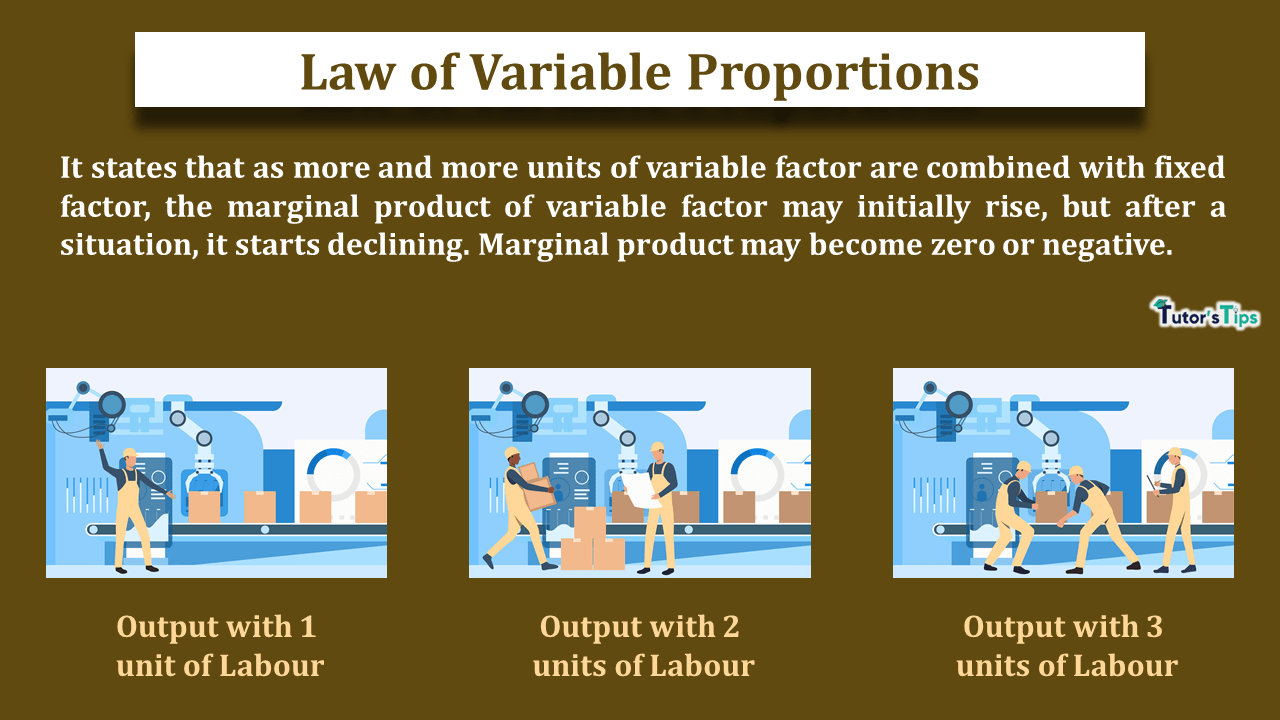
The law of variable proportions explains the effect of overexploitation of factors on output or production.
It states that as more and more units of a variable factor are combined with a fixed factor, the marginal product of variable factor may initially rise, but after a situation, it starts declining. Marginal Product may become zero or negative.
In the words of G.Stigler,
"As equal increments of one input are added; the inputs of other productive services being held constant, beyond a certain point the resulting increments of the product will decrease i.e. the marginal products will diminish."
According to F. Benham,
"As the proportion of one factor in a combination of factors os increased, after a point, first the marginal and then the average product of that factor will diminish."
For instance, Suppose 4 labours are required to cultivate a hectare of land. The marginal product of labour will increase if initially less than 4 workers are employed. Also, MP would be maximum when 4 workers are employed. Furthermore, it will start declining when more than 4 workers are employed.
Thus, in short, the law of variable proportions indicates the behaviour of output when more and more units of a variable factor are used with a fixed factor.
This law can be explained with the following illustration:
Suppose, using 1 hectare of land as fixed input and labour as a variable factor of input, a producer is able to produce:
| Units of land | Units of labour | Total Product | Marginal Product | |
| 1 | 0 | - | - | Increasing MP implies an increasing return to factor |
| 1 | 1 | 10 | 10-0 = 10 | |
| 1 | 2 | 25 | 25-10= 15 | |
| 1 | 3 | 45 | 45-25= 20 | |
| 1 | 4 | 55 | 55-45= 10 | Diminishing MP implies diminishing returns to a factor including negative returns |
| 1 | 5 | 60 | 60-55 =5 | |
| 1 | 6 | 60 | 60-60= 0 | |
| 1 | 7 | 55 | 55-60 = -5 |
The above table clearly shows that where the MP stops increasing, from that very point it starts diminishing. It represents that as more and more units of labour are used, the MP tends to rise till 3 units of labour are employed. In this situation, TP increases at an increasing rate. Therefore, it is known as the Situation of increasing returns to a factor.
But, with the application of the 4th unit of labour, the situation of diminishing returns set in; MP starts declining and TP increases only at the decreasing rate. After that, the diminishing MP reduces to zero and the total output is maximum when MP is zero. Eventually, MP can be negative. When TP starts declining, the MP becomes negative.
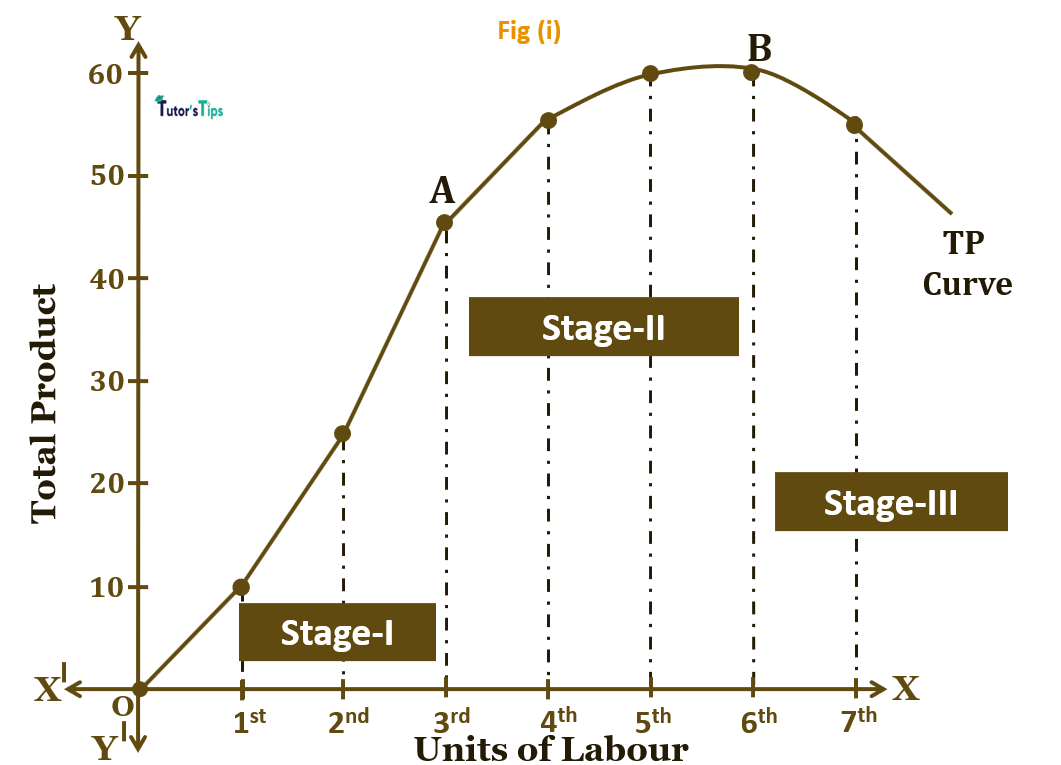
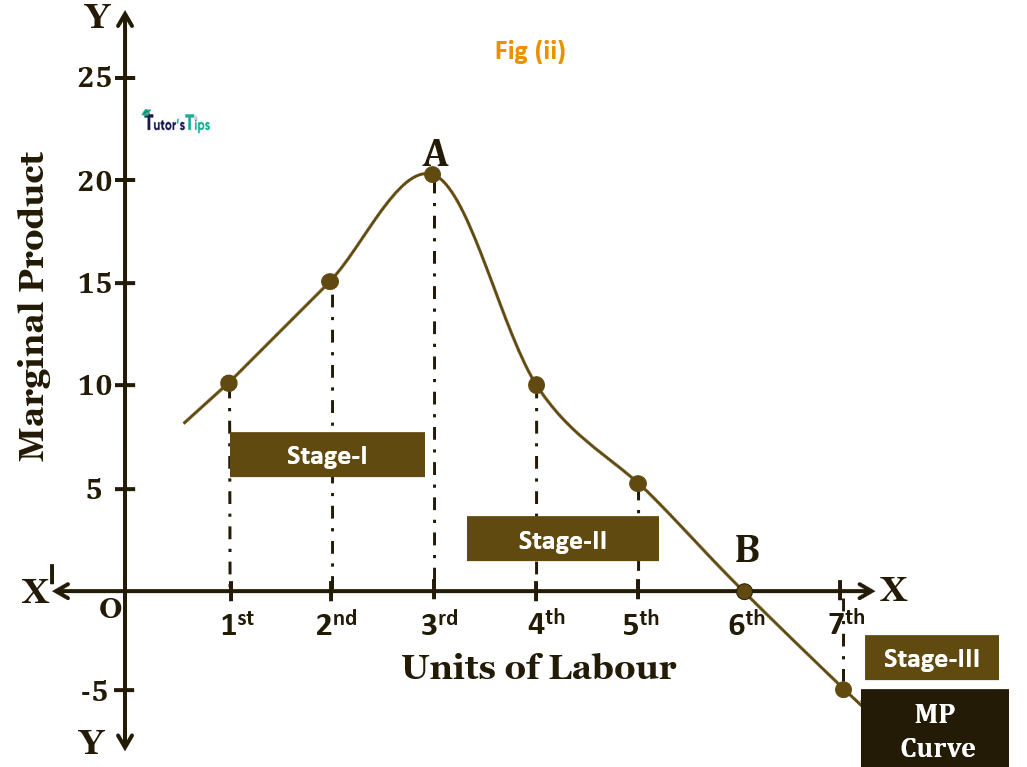
In fig (i), X-axis shows the units of labour used as a variable factor of input and Y-axis shows the total product. And in fig(ii), the X-axis shows the units of labour and Y-axis shows that the marginal product.
The figure depicts :
Increasing returns to a factor occur because of the following causes:
Increasing returns to a factor occur because of the following causes:
Economics Educator
Mrs. Dilgeerjot Kaur holds a B.Com and M.Com degree and has over 9 years of teaching experience in microeconomics, macroeconomics, and business economics.
The law of variable proportions explains the effect of overexploitation of factors on output or production. Meaning of Law of Variable Proportions: It states…
Class 11 and Class 12 commerce students, and CA Foundation aspirants, studying Economics Class 11.
Yes — this page includes a short interactive quiz so you can check your understanding straight away.