Loading Tutorstips...
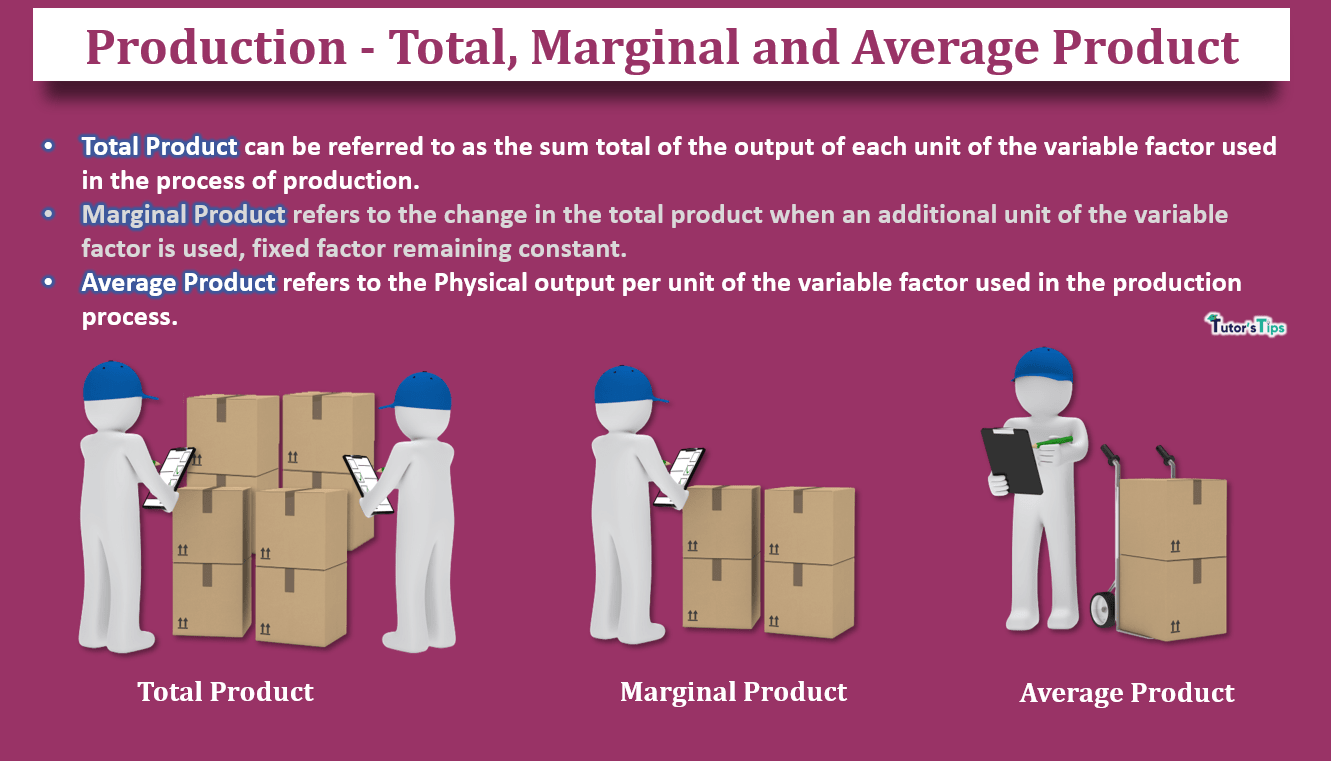
The total product, marginal product and average product are vital aspects of production or output.
Production refers to the amount of output using variable and fixed factors of production as inputs. In other words, it is the quantity of goods and services produced by a firm or industry whether to consume or to use in further processing.
Subscribe our Youtube Channel
The production can be classified as:
Total product is the sum total of output produced by all the units of variable inputs with a constant amount of fixed input used in the process of production. It is also known as Total Physical Product or TPP or TP.
Suppose, using Land as fixed factor and labour as a variable factor, the producer is able to produce :
| Labour used as a variable input (in units) | Product/ output (in units) |
| 1 | 5 |
| 2 | 10 |
| 3 | 15 |
| 4 | 10 |
| 5 | 5 |
| Total Product= |
5+10+15+10+5 = 45 units |
Here, with one unit of labour, the producer is able to produce 5 units of a commodity. But, as he increases the use of labour to 2 nits, the output also increases to 10 units. Likewise, 3 units of labour increase the output to 15 units, which is maximum. As, after this, the increase in employment of labour decreases the output to 10 units and then to 5 units. Thus, the Total Product can be referred to as the sum total of the output of each unit of the variable factor used in the process of production. Hence, it is also known as Total Return of the Variable Factor.
Marginal Product refers to the change in the total product when one more unit of the variable factor is used with constant use of fixed factor. It is also called ass Marginal Physical Product or MPP or MP.
It can be calculated as:
MPn = TPn - TPn-1
Here,
MPn denotes the Marginal Product from using nth unit of the variable factor
TPn denotes Total Product from nth unit of the variable factor
TPn-1 denotes Total Product from (n-1)th unit of the variable factor
Suppose, using Land as fixed factor and labour as a variable factor, the producer is able to produce :
| Labour used as a variable input (in units) | Total Product/ output (in units) |
Marginal Product (in units) |
| 1 | 5 | 5-0 =5 |
| 2 | 8 | 8-5=3 |
| 3 | 15 | 15-8=7 |
| 4 | 12 | 12-15=-3 |
| 5 | 10 | 10-12 =-2 |
| Total Product= |
5+10+15+10+5 = |
|
Here, with one unit of labour, the producer is able to produce 5 units of a commodity. But, as he increases the use of labour to 2 units, the output also increases to 10 units resulting in a marginal product as 5 units. Likewise, 3 units of labour increase the output to 15 units, which is maximum with the maximum marginal product as 7 units. As, after this, the increase in employment of labour decreases the output to 10 units and then to 5 units leading to the negative marginal product as -3 and -2 respectively. Thus, the Marginal Product refers to the change in the total product when an additional unit of the variable factor is used, fixed factor remaining constant.
Therefore, the Total Product is the total of Marginal Product corresponding to each unit of the variable factor.
It refers to the output per unit of the variable factor. It can be calculated as :
AP = TP/ L
Here,
AP denotes Average Product
TP denotes Total Product
L denotes the units of the variable factor
For Example, If the total product is 50 units when 10 units of labour are used, then:
AP = 50/10 = 5 units of output
Suppose, using Land as fixed factor and labour as a variable factor, the producer is able to produce :
| Labour used as a variable input (in units) | Total Product/ output (in units) |
Average Product (in units) |
| 1 | 5 | 5/1 =5 |
| 2 | 8 | 8/2=4 |
| 3 | 9 | 9/3=3 |
| 4 | 8 | 8/4=2 |
| 5 | 5 | 5/5=1 |
| Total Product= |
5+10+15+10+5 = |
|
Here, with one unit of labour, the producer is able to produce 5 units of a commodity with an average product of 5 units. But, as he increases the use of labour to 2 units, the output also increases to 10 units resulting to an average product as 4 units. Likewise, 3 units of labour increase the output to 15 units, which is maximum with the average product as 3 units. As, after this, the increase in employment of labour decreases the output to 10 units and then to 5 units leading to the marginal product as 2 and 1 unit respectively.
Thus, the Average Product refers to the Physical output per unit of the variable factor used in the production process.
Economics Educator
Mrs. Dilgeerjot Kaur holds a B.Com and M.Com degree and has over 9 years of teaching experience in microeconomics, macroeconomics, and business economics.
The total product, marginal product and average product are vital aspects of production or output. What is Production : Production refers to the amount of…
Class 11 and Class 12 commerce students, and CA Foundation aspirants, studying Economics Class 11.
Yes — this page includes a short interactive quiz so you can check your understanding straight away.