Loading Tutorstips...
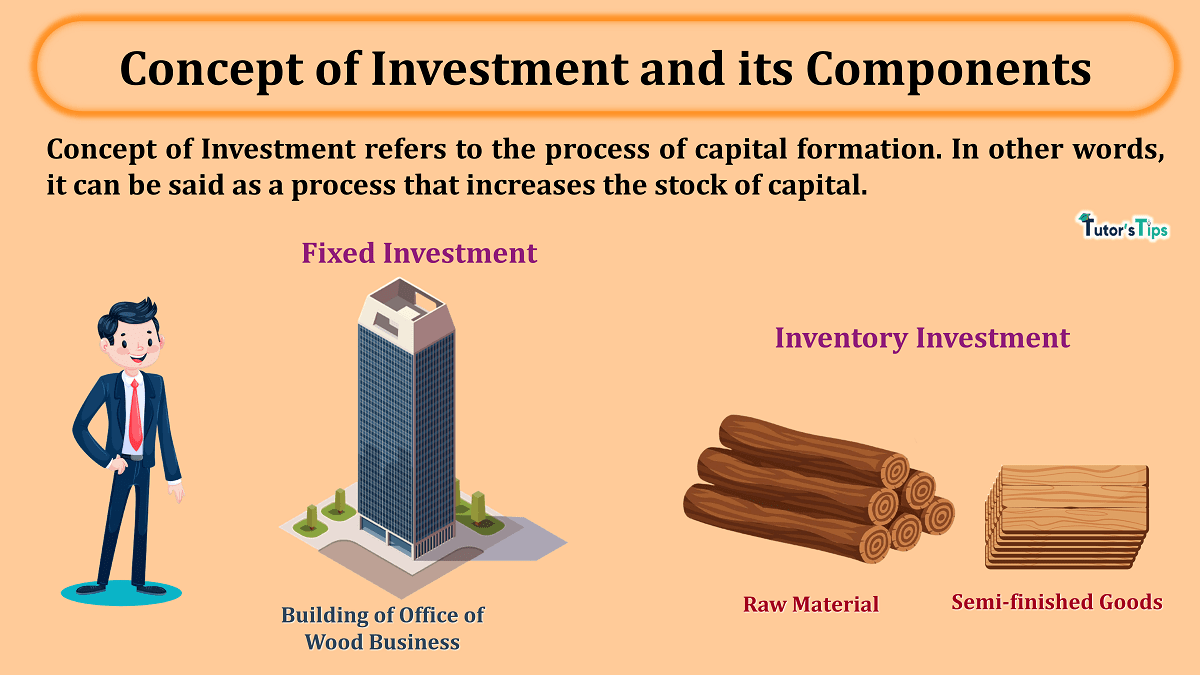
Concept of Investment refers to the process of capital formation. In other words, it can be said as a process that increases the stock of capital.
Investment refers to the mechanism used for generating future income. As we know capital is a stock of produced means of production. Or, we can say capital is the stock of man-made goods which are used for further production. Thus, capital stock is the production capacity of the production units. Larger the capital stock, larger would be the production capacity of producers. Hence, the producers always want to increase their capital stock, so that their production capacity can increase with time. This increase in the stock of capital during the year is called investment during the year.
Thus,
I = ΔK
Where,
I refer to Investment
K refers to Capital Stock
ΔK refers to change in capital stock during the year.
This change in capital stock or investment is also known as capital formation. Hence, investment is the process of capital formation or process in which capital stock is increased.
It refers to the increase in the stock of fixed assets of the producers during a year. In other words, it can be described as the expenditure incurred by producers on purchase of long term assets or capital goods during the year. For example, Plant and machinery, Furniture and Building etc.
It can be calculated as:
Fixed investment during the year = Stock of fixed assets at the end of the year - Stock of fixed assets in beginning of the year
For example,
Let's assume, a producer has a stock of 20 machines at the beginning of year i.e. 1st Jan 2020. On 31st December 2020, he has a stock of 35 machines. Thus, the fixed assets stock of producer is increased by 15 machines during the year.
Therefore, fixed investment during the year 2020 = 15 machines.
Due to this, fixed investment is also known as Fixed capital formation. It means the increase in capital in terms of fixed assets which are used in the process of production for several years.
It refers to the change in the stock of finished, semi-finished and raw material during a year. Here, the finished goods refer to the final goods ready to sale or unsold. Semi-finished goods include goods which are in the process of production. The stock of these goods is known as Inventory stock. It keeps on varying with the passage of time. Thus, the change inventory stock during the year is known as inventory investment of producers.
It can be calculated as:
Inventory investment during the year = Inventory stock at the end of the year - Inventory stock at the beginning of the year.
For example,
Let's assume the producer has 1,25,000 units of inventory stock including finished, semi-finished goods and raw material at the beginning of year i.e. 1st Jan 2020. On 31st December 2020, he has 2,25,000 units of inventory stock with him. Thus, the inventory stock of producer is increased by 1,00,000 units.
Therefore,
Inventory stock during the year = 1,00,000 units.
Inventory investment basically consists of investment in terms of raw material and finished goods.
Desired inventory stock refers to the planned inventory stock maintained by the producers to meet future demand in the market.
Undesired inventory stock refers to the unplanned inventory stock. When the demand in the market turns out to be less than the expected. It results in more inventory stock with the producers. This unplanned stock inventory leads to losses of producers.
For example,
Suppose, the producers plan to sell 1,500 units out of 2,000 units of a product. It is so because they want to have 500 (2,000-1,500) units with themselves to meet future demand. Therefore, these 500 units would be considered as desired inventory stock.
But if, actually they could sell only 1,000 units in the market due to low demand. In such a case, 500 units (1,500-1,000) units would be the undesired inventory stock.
Thanks!!!
Economics Educator
Mrs. Dilgeerjot Kaur holds a B.Com and M.Com degree and has over 9 years of teaching experience in microeconomics, macroeconomics, and business economics.
Concept of Investment refers to the process of capital formation. In other words, it can be said as a process that increases the stock of capital. Concept of…
Class 11 and Class 12 commerce students, and CA Foundation aspirants, studying Economics Class 12.
Yes — this page includes a short interactive quiz so you can check your understanding straight away.