Loading Tutorstips...
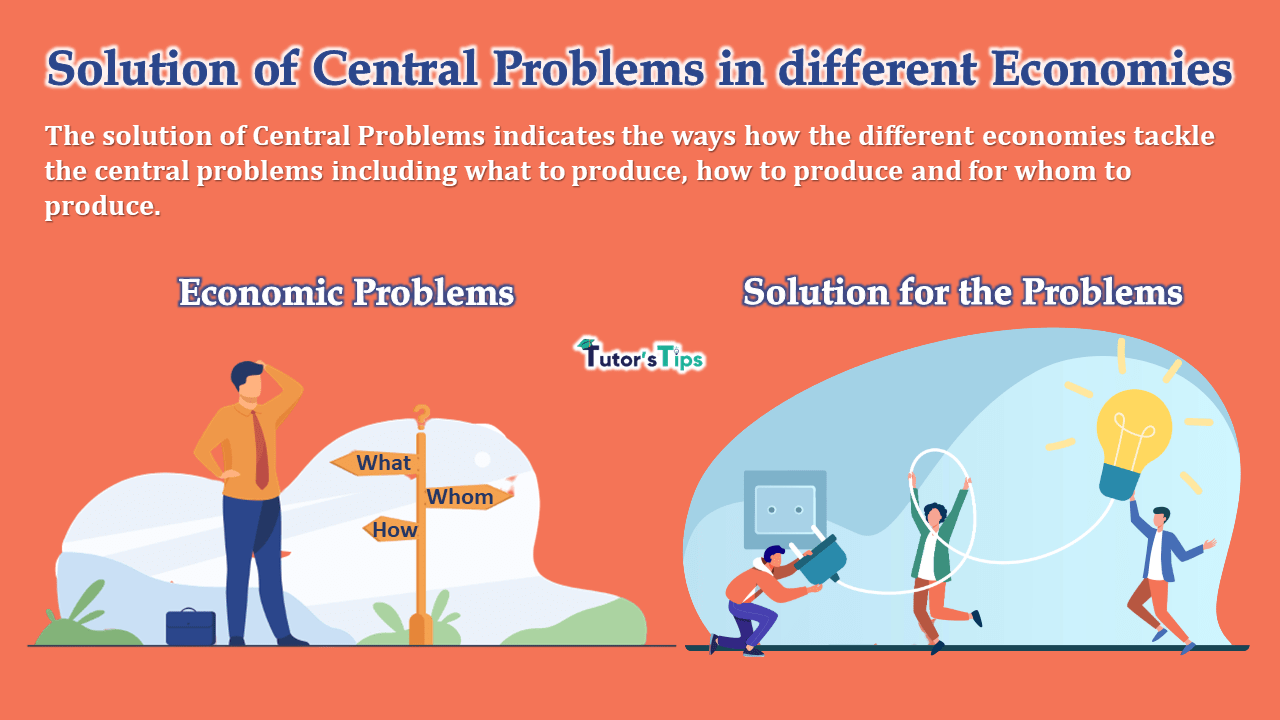
The solution of Central Problems indicates the ways how the different economies tackle the central problems including what to produce, how to produce, and for whom to produce.
Different economies solve central problems differently. To understand this, we can explain it differently as under:
Subscribe to our Youtube Channel
It is the economy where the economic activities are controlled by market forces such as demand and supply. The market economy is dominated by the private sector. Thus, it means that the producers are free to take decisions regarding central problems. On the basis of market forces, the producers make decisions in the market. These decisions are:
The producers will produce those goods which offer them high profits. In other words, they prefer to produce goods that are highly in demand in the market. As high demand goods have high prices and thus, results in high profits.
To select the technique of production, the producers will always use that technology which gives maximum efficiency and minimum cost to them.
In this type of economy, the producers will produce for those people who can afford to pay a high price. This is because high prices bring high profits for the producers. On the other hand, the poorer section of society is always ignored. Hence, it causes the problem of an economic gulf in the economy. In other words, the production of goods for rich people in society results in more gulf between the rich and the poor in society.
It is the economy where the economic activities are controlled by the government or some central authority. In this, The market economy is dominated by the public sector. Thus, it means that the government is free to take decisions regarding central problems on the basis of social welfare. These are:
Those goods and services would be produced in the economy, which is regarded as most useful for society by the central authority. For instance, transport, defense, and police, etc.
To select the technique of production, the government will select that technique that would is socially most desirable. For instance, in the situation of mass unemployment, the labor-intensive technique would be adopted to reduce unemployment rather than the capital-intensive technique.
In this type of economy, the government will produce for the poorer section of society. It is to be ensured by the authority that enough goods are being produced for poor people even when the production of such goods is not profitable. Consequently, social justice is given priority over profit maximization.
It is the economy where the economic activities are governed by the market forces and regulated by the government. In this, The market economy is dominated by both the public and private sectors. Thus, it means that the decisions are taken both to maximise the profits and social welfare. These are:
In certain areas of production, producers are free to take their decisions with a view to maximizing profits. Whereas in other areas, the decisions are taken on the basis of social considerations. For instance, In India, the producers are free to produce steel and cotton to maximize profits. But, 'railways' is the monopoly of the government. The authority provides transport facilities at nominal rates so that the poorer sections can avail of them.
To select the technique of production, the producers will always use that technology which gives maximum efficiency and minimum cost to them whereas the government will select that technique which would is socially most desirable.
In this type of economy, the producers will produce for those people who can afford to pay a high price. This is because high prices bring high profits for the producers. On the other side, the government will produce for the poorer section of society. It would be ensured by the authority that all the basic facilities are availed by the poorer sections in the society.
Thanks for reading the topic.
Economics Educator
Mrs. Dilgeerjot Kaur holds a B.Com and M.Com degree and has over 9 years of teaching experience in microeconomics, macroeconomics, and business economics.
The solution of Central Problems indicates the ways how the different economies tackle the central problems including what to produce, how to produce, and for…
Class 11 and Class 12 commerce students, and CA Foundation aspirants, studying Economics Class 11.
Yes — this page includes a short interactive quiz so you can check your understanding straight away.
14 November 2022
23 November 2022
17 July 2024
19 July 2024