Loading Tutorstips...
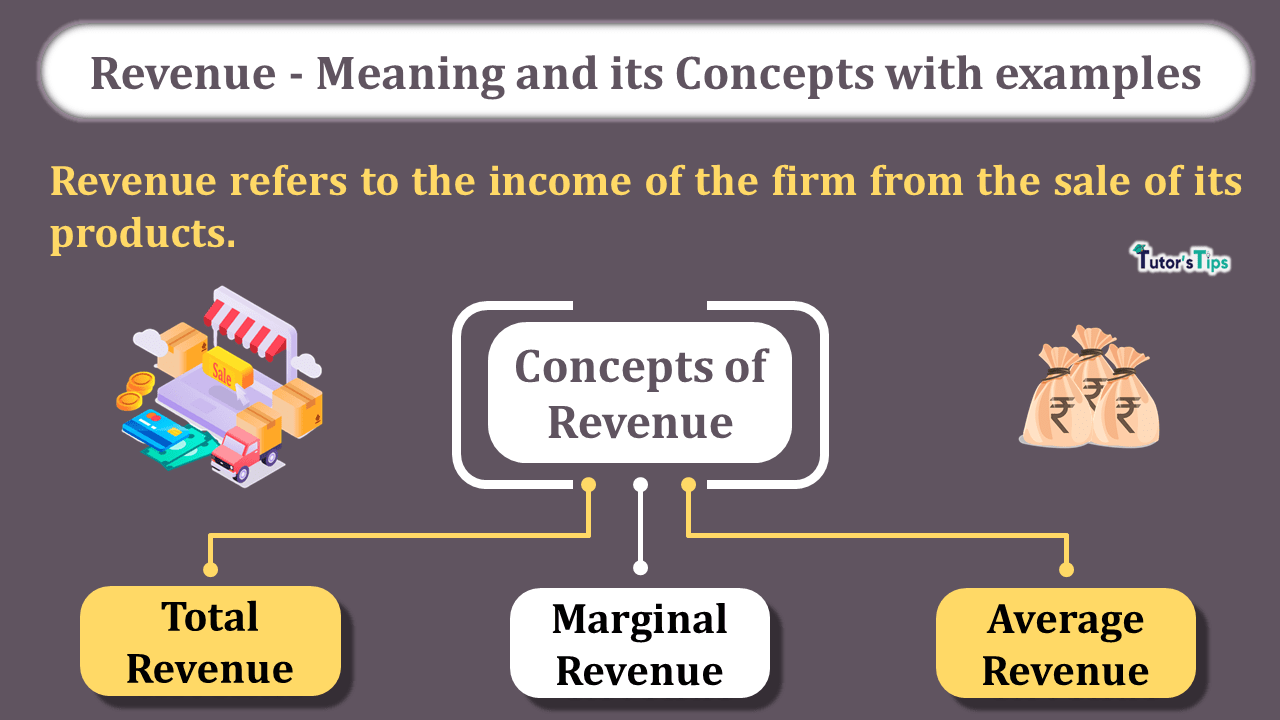
Meaning of Revenue refers to the income of the firm from the sale of its products. This concept includes total, marginal and average revenue as its components.
It refers to the money received by a firm by selling its products or commodities.
In the words of Dooley,
"The revenue of a firm is its sale receipts or money receipts from the sale of a product."
Example:
Suppose, a firm produces 500 units of chocolates in a day and by selling these units, the firm gets Rs.2500. Thus, The amount of Rs.2500 is regarded as revenue in economics which a firm gets by selling its products.
Here, it is very important to understand that this term is different from the term profit. As it is the money received by selling products whereas profit refers to the difference between revenue and costs. It can be expressed as:
Profit = Revenue - Costs
It includes the following concepts:
It refers to the total money receipts of a firm from the sale of a given output. TR can be calculated as:
TR = Price × Quantity
or
TR = AR × Q
Here,
TR represents total revenue
AR represents revenue per unit
Q represents total output
Thus, We can say that TR refers to the money receipts of a firm from the sale of its total output and can be estimated as:
TR = AR × Q
In the words of Dooley,
"Total Revenue is the sum of all sales receipts or income of a firm."
If a firm sells 200 units of chocolates at the rate of Rs. 5 per unit in a day, then TR would be
TR = Price × Quantity
= 5 × 200
= Rs.1000
It refers to the change in the TR when one more unit of a commodity is sold.
Therefore, It can be estimated as :
MR = TRn- TRn-1
Also, When it is difficult to measure the increase in units sold, The calculation of MR :
| MR | = | ΔTR |
| ΔQ |
Here,
MR denotes Marginal Revenue
ΔTR denotes a change in TR
ΔQ denotes a change in quantity
In the words of Ferguson,
"Marginal Revenue is the change in total revenue which results from the sale of one more or less unit of output."
Suppose a firm gets Rs.500 as TR by selling 50 units and it becomes to Rs 510 by selling 51 units. Then, the additional income can be calculated as:
MR = TR51- TR50
= 510 - 500
= Rs.10
It can also be estimated as:
| MR | = | ΔTR |
| ΔQ |
Here,
ΔTR = Rs.(510-500) = Rs 10
ΔQ = 51-50 = 1
Therefore,
MR = 10 ÷ 1 = Rs.10
It refers to the income received per unit and can be calculated as:
AR = TR / Q
In the words of McConnel,
"Average Revenue is the per-unit revenue received from the sale of a commodity."
Suppose a firm gets Rs.500 as income by selling 50 Units in a day. Then,
AR = TR/Q
= 500/50
=Rs. 10
Economics Educator
Mrs. Dilgeerjot Kaur holds a B.Com and M.Com degree and has over 9 years of teaching experience in microeconomics, macroeconomics, and business economics.
Meaning of Revenue refers to the income of the firm from the sale of its products. This concept includes total, marginal and average revenue as its components.…
Class 11 and Class 12 commerce students, and CA Foundation aspirants, studying Economics Class 11.
Yes — this page includes a short interactive quiz so you can check your understanding straight away.
1 February 2022
2 February 2022