Loading Tutorstips...
Today we are covering the technical and theoretical topic of the Reserve. So please read it very consciously and in this article, you will learn the meaning of the Reserve, types of Reserve, accounting treatment of Reserve and we will make it an understandable topic in much better ways with the help of examples.
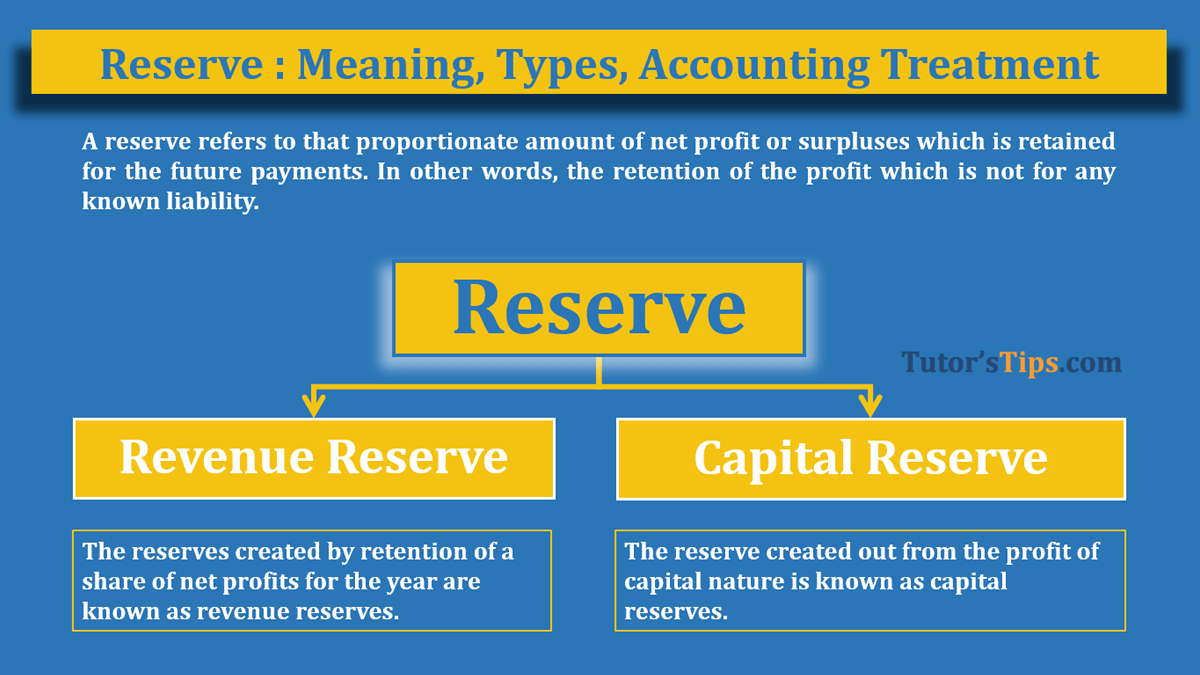
A reserve refers to the proportionate amount of net profit or surpluses which is retained for future payments. In other words, the retention of the profit is not for any known liability.
According to William Pickles. "Reserve means the amount set aside out of profit and other surpluses, which are not earmarked in any way to meet any particular liability known to exist on the date of Balance Sheet."
"According To Part III, Schedule VI of the Companies Act, 1956,
The expression 'reserves' shall not include any amount written off or retained by way of providing for depreciation, renewals or diminution in value of assets or retained by way of providing for known liability. However, if the amount of provision is in excess of the amount which in the opinion of the directors is reasonably necessary for the purpose, the excess shall be treated as a reserve and not as a provision."
The reserves created by the retention of a share of net profits for the year are called revenue reserves. The creation of reserves by retention of profits is simply an appropriation of net profits. It does not affect the amount of net profit to pay the tax liability but it reduces the share of profit available for distribution among the shareholder, partners, or Owner. Revenue Reserve is also known as "Retained Earnings", "Undistributed Profits" or "Retained Profits".
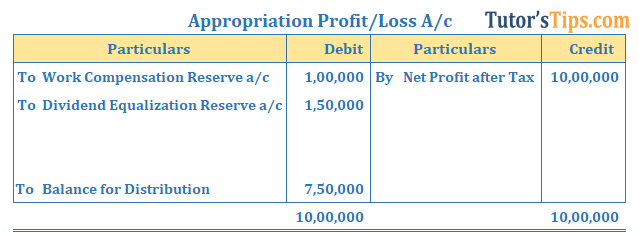
To create "Revenue Reserves" we have to make an account named "Appropriation Profit/Loss account" after making of profit/loss account (income statement). The example of the Appropriation Profit/Loss account is shown below.
The reserve created out from the profit of capital nature is known as capital reserves. These reserves are not free for distribution among the Owner of the business by way of dividend. Generally, These profits are not available for distribution. The following are some names of Capital profit or gain.
Basis |
Revenue |
Capital |
|---|---|---|
| Meaning | The retention of a share of net profits for the year | The reserve created out from the profit of capital nature |
| Affect on Net Profit | It does not affect the Net profit. | It does affect the Net profit |
| Source | It is created out from net profit. | it is created out from capital gain/profit. |
| During loss year | It can not be created in the loss year. | It can be created in the loss year. |
| Object | To strengthen the financial position and to meet the unknown liability. | to meet the capital loss of compliance of legal requirements. |
| Payment of Dividend | The dividend can be paid out of it without any preconditions | The dividend can be paid out of it with any preconditions of the company act. |
Accounting & Commerce Educator
Sarbjit Singh holds a B.Com and M.Com degree and has over 12 years of teaching experience in double entry bookkeeping, financial accounting, and business studies.
Today we are covering the technical and theoretical topic of the Reserve. So please read it very consciously and in this article, you will learn the meaning of…
Class 11 and Class 12 commerce students, and CA Foundation aspirants, studying Financial Accounting.
Yes — this page includes a short interactive quiz so you can check your understanding straight away.
19 October 2020
11 November 2021
14 November 2021