Loading Tutorstips...
Question No 6 Chapter No 5
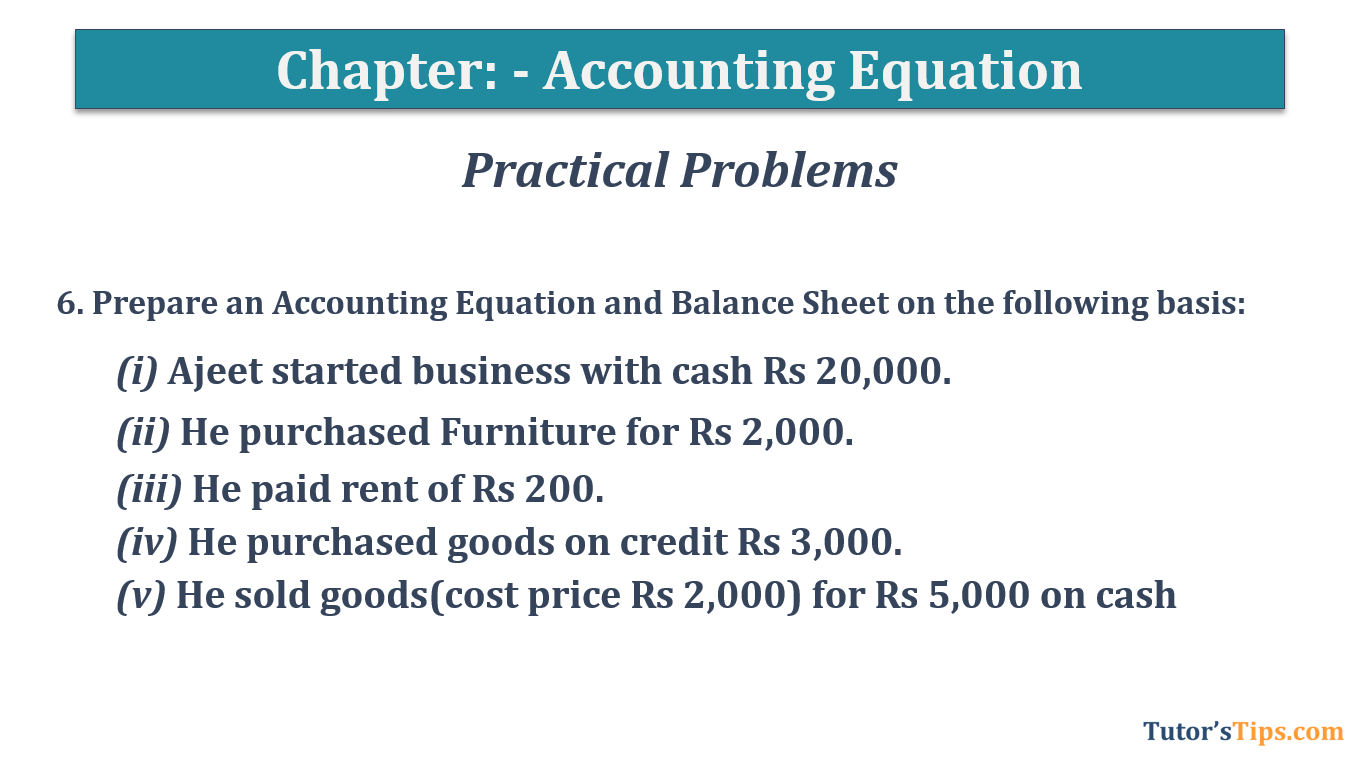
6. Prepare an Accounting Equation and Balance Sheet on the following basis:
(i) Ajeet started the business with cash of Rs 20,000.
(ii) He purchased Furniture for Rs 2,000.
(iii) He paid rent of Rs 200.
(iv) He purchased goods on the credit of Rs 3,000.
(v) He sold goods(cost price Rs 2,000) for Rs 5,000 on cash
Subscribe to our Youtube Channel
| S. No. | Particulars | Assets |
Liabilities |
Capital | ||
|---|---|---|---|---|---|---|
| Cash | +Furniture | +Stock | +Creditors | |||
| (i) | Ajeet started business with cash Rs 20,000. | +20,000 | - | +20,000 | ||
| 20,000 | - | +20,000 | ||||
| (ii) | He purchased Furniture for Rs 2,000. | -2,000 | +2,000 | - | - | |
| 18,000 | +2,000 | - | +20,000 | |||
| (iii) | He paid rent of Rs 200. | -200 | -200 | |||
| 17,800 | +2,000 | - | +19,800 | |||
| (iv) | He purchased goods on credit Rs 3,000. | - | - | +3,000 | +3,000 | - |
| +17,800 | +2,000 | +3,000 | 3,000 | +19,800 | ||
| (v) | He sold goods(cost price Rs 2,000) for Rs 5,000 on cash | +5,000 | - | -2,000 | - | +3,000 |
| Total | 22,800 | +2,000 | +1,000 | 3,000 | 22,800 | |
Answer: -
Assets = Cash 22,800 + Furniture 2,000 + Stock 1,000= 25,800/-
Liabilities = 3,000/-
Capital = 22,800/-
Liabilities +Capital
3,000 + 22,800 = 25,800/-
This is not a part of the solution, So you don't have to write it in the exam. So why we explained if it is not needed. Because This explanation will help you to understand all transactions with logic so don't need to remember all the transactions but just understand and remember the logic use behind it.
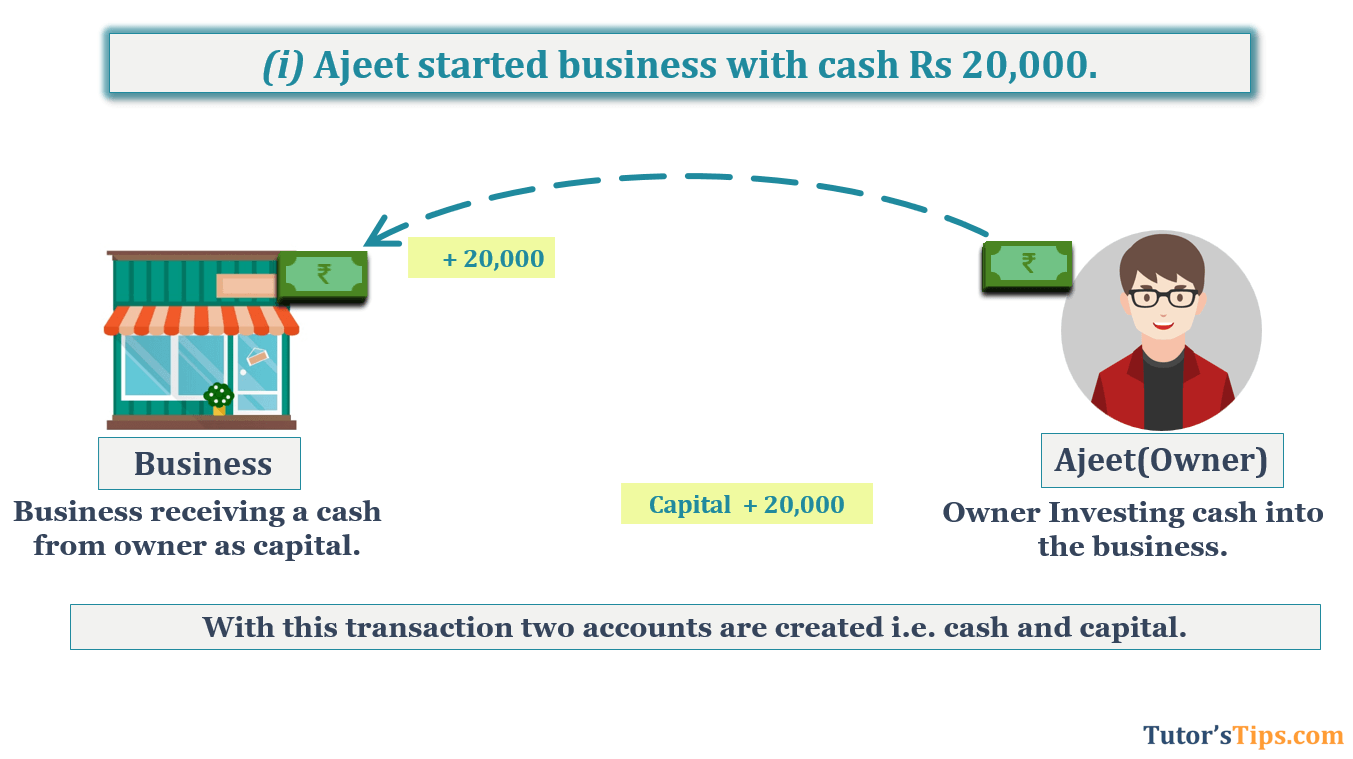
As we discuss in the previous topic, A owner and a business both have a separate identity in the eye of law. So, the business will be treated as an Artificial Person and anything invested by the owner into the business will be treated as capital.
So, In this transaction, as shown in the above image owner investing her cash into the business, this will be treated as capital of the business. The business receiving an asset i.e. cash.
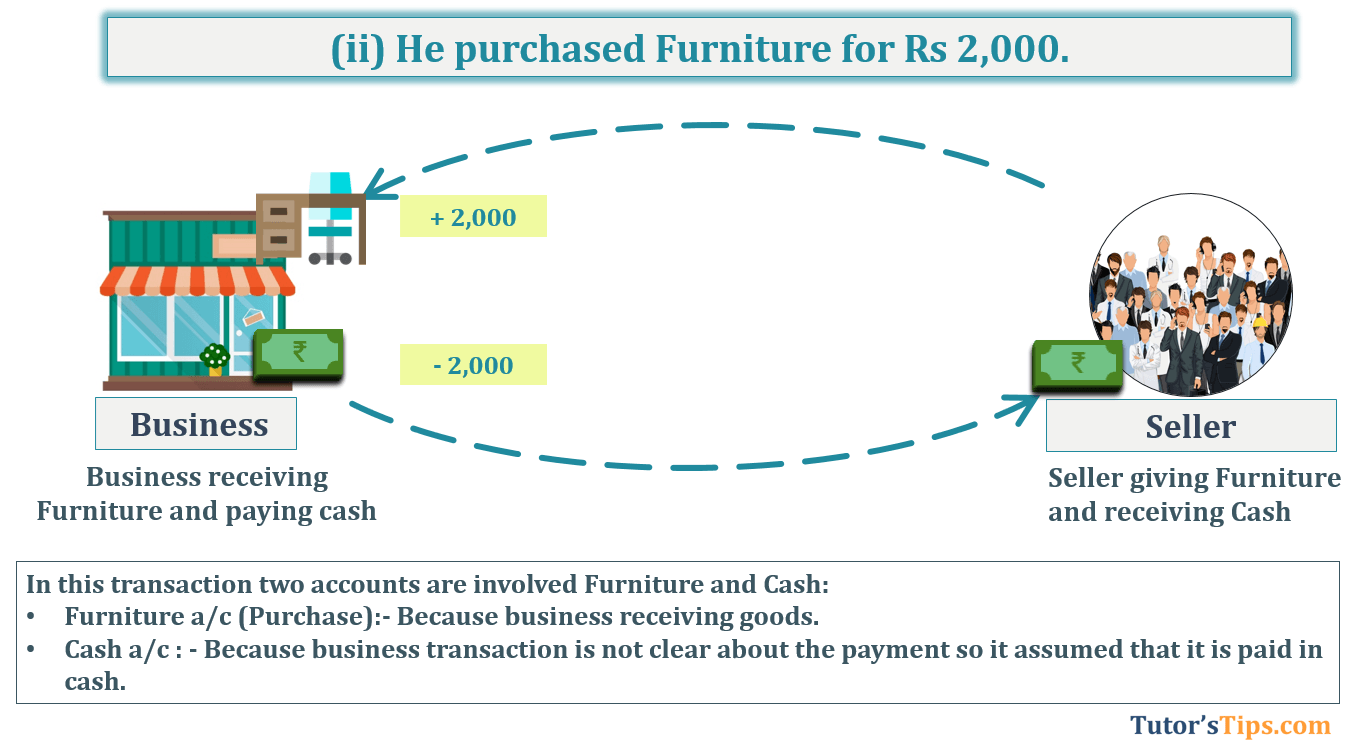
In this transaction, as shown in the above image two accounts are involved Furniture and Cash:
Furniture a/c (Purchase):- Because business receiving goods.
Cash a/c: - Because the business transaction is not clear about the payment so it assumed that it is paid in cash.
Transaction No. 3
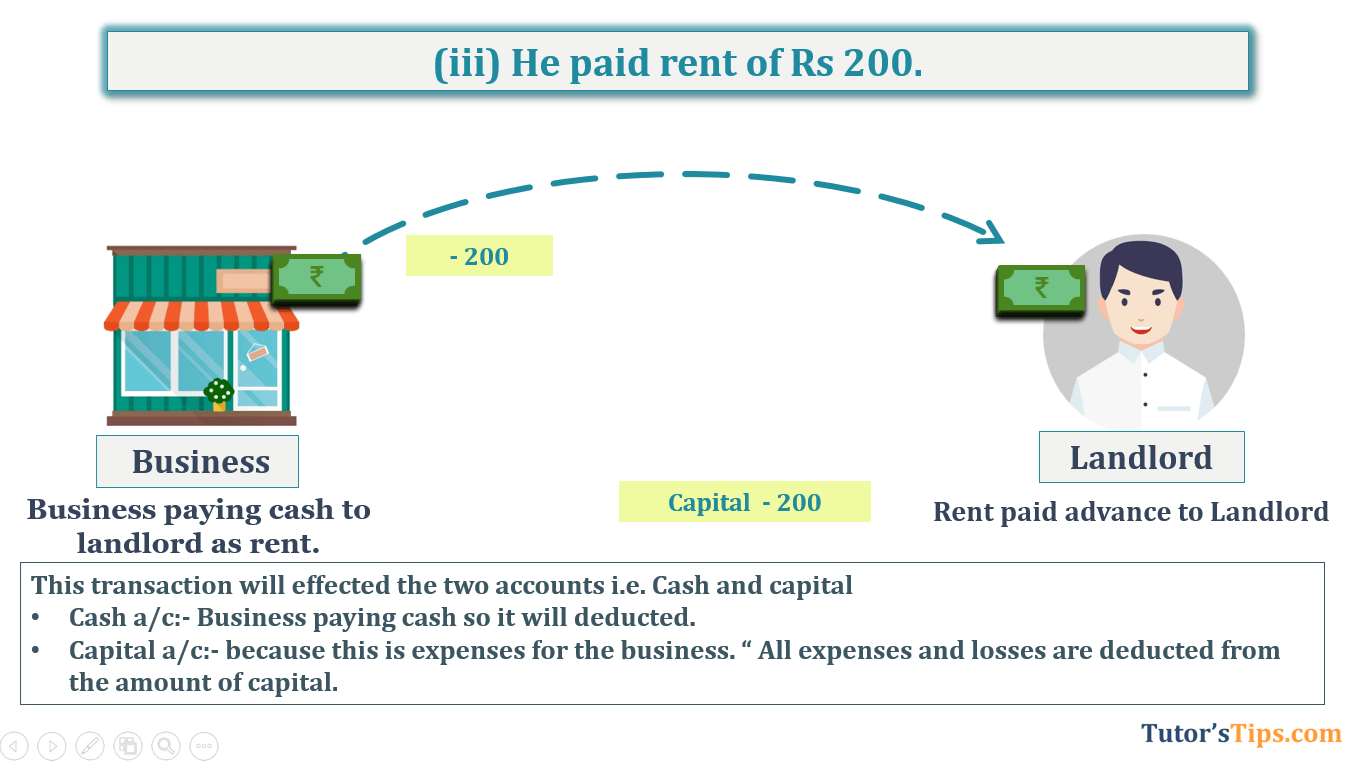
In this transaction, as shown in the above image the two accounts are involved i.e. Cash and capital
Cash a/c:- Business paying cash so it will be deducted.
Capital a/c:- because this is expenses for the business. “ All expenses and losses are deducted from the amount of capital.
Transaction No. 4
Transaction No. 4 Question No.6 - Chapter No.5- T.S. Grewal +1 Book 2019
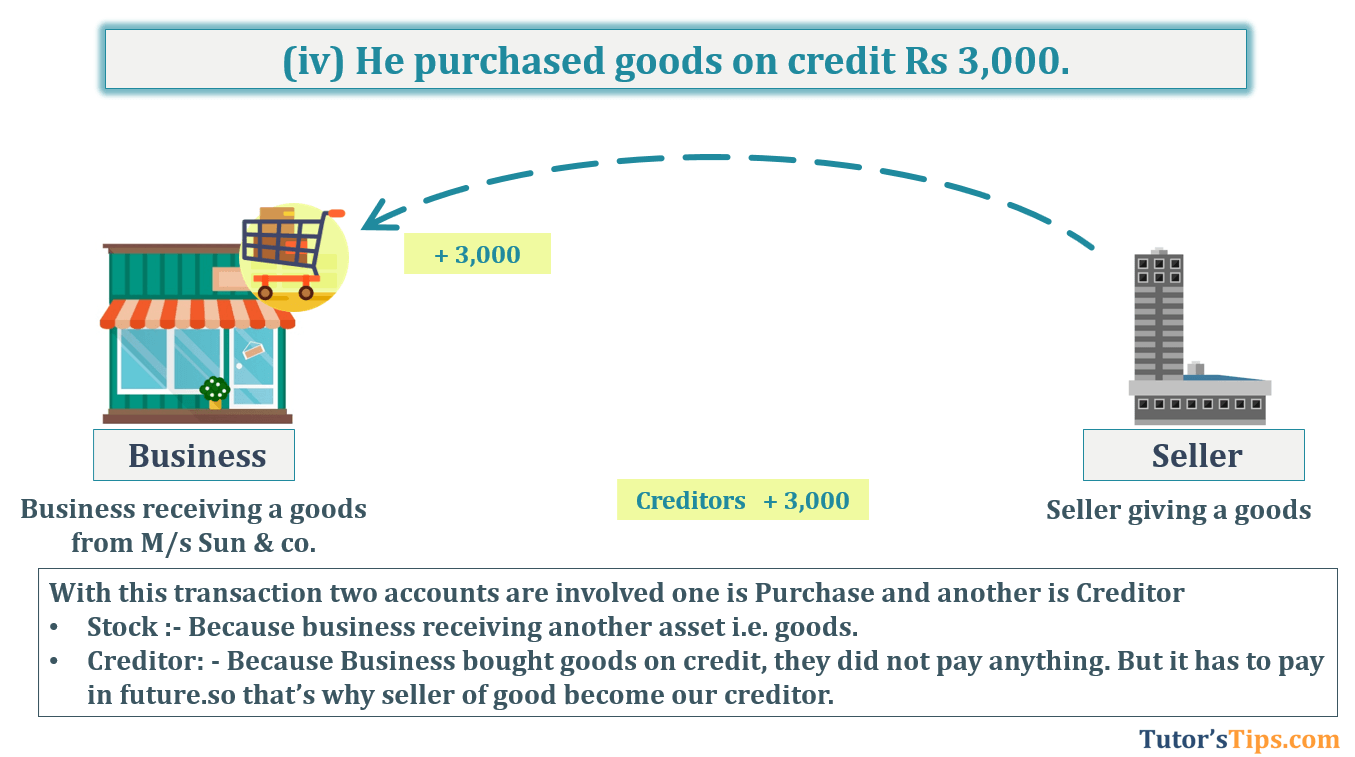
In this transaction, as shown in the above image two accounts are involved one is Stock (Purchase) and another is Creditor
Stock:- Because business receiving another asset i.e. goods.
Creditor: - Because Businesses bought goods on credit, they did not pay anything. But it has to pay in the future. so that’s why the seller of a good becomes our creditor.
Transaction No. 5
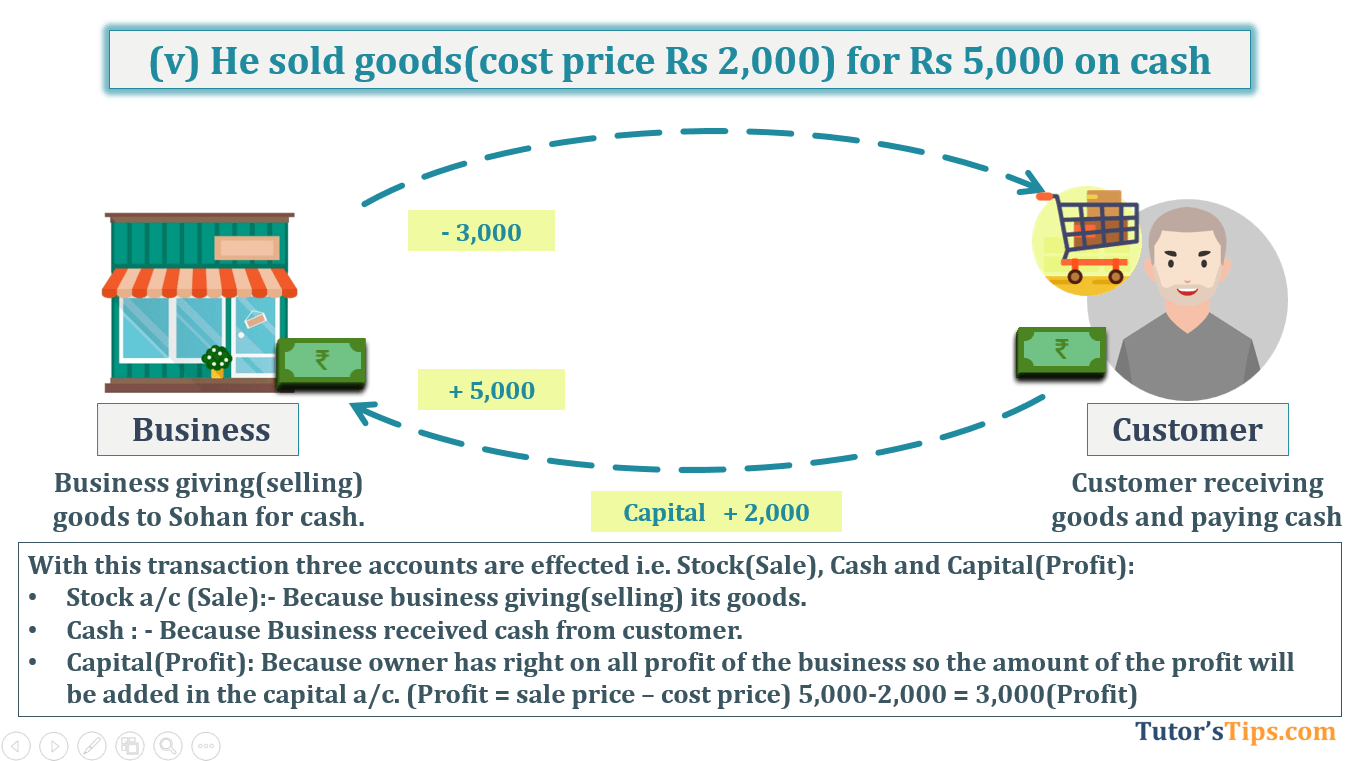
In this transaction, as shown in the above image three accounts are affected i.e. Stock(Sale), Cash, and Capital(Profit):
Stock a/c (Sale):- Because business giving(selling) its goods.
Cash: - Because Business received cash from the customer.
Capital(Profit): Because owner has the right to all profit of the business so the amount of the profit will be added in the capital a/c. (Profit = sale price – cost price) 5,000-2,000 = 3,000(Profit)
Thanks Please share with your friends
Comment if you have any question.
Check out T.S. Grewal's +1 Book 2019 @ Official Website of Sultan Chand Publication
T.S. Grewal's Double Entry Book Keeping
Accounting & Commerce Educator
Sarbjit Singh holds a B.Com and M.Com degree and has over 12 years of teaching experience in double entry bookkeeping, financial accounting, and business studies.
This guide covers "Question No 6 Chapter No 5 - T.S. Grewal 11 Class", focusing on key definitions, step-by-step concepts, applications, and revision guidelines relevant to T.S. Grewal 11 Class Financial Accounting.
It is primarily curated for Class 11 and Class 12 high school commerce, accounting, and economics students, as well as aspirants preparing for board exams or CA Foundation.
You can take our custom-built interactive practice quiz directly on this page to test your understanding of "Question No 6 Chapter No 5 - T.S. Grewal 11 Class" instantly.