
Loading Tutorstips...
An error means a mistake. When we are doing some work here a number of chances to do mistakes also. So, while an accountant recording, posting, or balancing the ledger account there are numbers of chances that he did a mistake in his work this type of mistake is known as accounting errors. The process of rectifying these mistakes is known as error rectification.
The trial balance is prepared to check the arithmetical accuracy of recording the transactions in the journal, posting to the ledger, and balancing of ledgers accounts. When the trial balance is agreed then it is assumed that the all process of journalizing, posting, and balancing has no error. If the trial balance is not agreed then it is means there are errors in any above-said processes and efforts are made to detecting an error.
But the agreement of trial balance is not the proof of all error-free accounting there is some type of errors which will not affect the total of trial balance. For example, Non-recording of the whole transactions in the books, will not affect the total of the trial balance because we recorded neither debit nor credit. So, we can divide all errors into the two main headings, i) Error which is revealed by the trial balance and, ii) Error which is not revealed by the trial balance.
In the books of accounts, errors may occur at any stage like journalizing, posting, balancing, and preparation of trial balance. So, all the errors, whether affecting trial balance or not, are classified on the basis of their nature into the following four categories:-
Read the full article.
[pt_view id="83b02baf2e"]
Check out T.S. Grewal +1 Book 2019 @ Official Website of Sultan Chand Publication
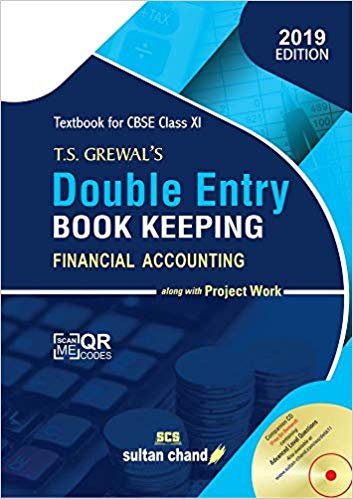
T.S. Grewal’s Double Entry Book Keeping
Accounting & Commerce Educator
Sarbjit Singh holds a B.Com and M.Com degree and has over 12 years of teaching experience in double entry bookkeeping, financial accounting, and business studies.
This guide covers "Chapter No. 17 - Rectification of Errors - Solution", focusing on key definitions, step-by-step concepts, applications, and revision guidelines relevant to Academic Subjects.
It is primarily curated for Class 11 and Class 12 high school commerce, accounting, and economics students, as well as aspirants preparing for board exams or CA Foundation.
You can take our custom-built interactive practice quiz directly on this page to test your understanding of "Chapter No. 17 - Rectification of Errors - Solution" instantly.