Loading Tutorstips...
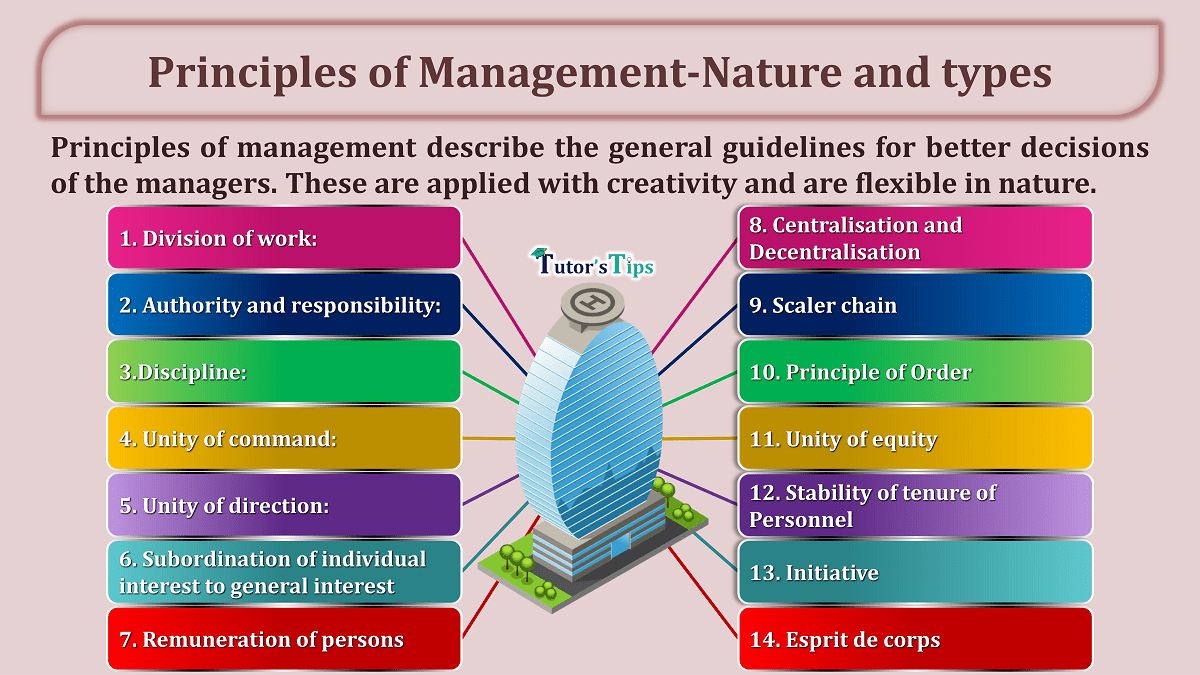
Principles of management describe the general guidelines for better decisions of the managers. These are applied with creativity and are flexible in nature. These Principles are formed by observation and experiments.
Principles of management are given by Henry Fayol(father of management studies and thoughts). He was born in France in 1841. He got a degree in mining engineering in 1860 and then start working as an engineer in a coal mining company. The situation of the company was worse at that time, to improve the working conditions of the company he accepts the challenges and applied his managerial techniques to bring out the company from this situation and got success.
He develops the functions of management and puts these functions according to the sequence: planning, organizing staffing, directing, controlling.
He develops 14 principles of management to perform the managerial activities for the desired goals of the organization.
Fayo suggested that work should be divided into small units and creating departments instead of assigning the whole work to one person. The work should be divided according to the qualification of the workforce for better results.
When the work is divide according to the qualification then it leads to specialization. and specialization helps in improving the efficiency of the work.
This principle is mainly focused on the parity between authority and responsibility. Authority means power to take decisions and responsibility is the obligation to complete the work on time.
It refers to the following of rules and regulations, code of conduct. Discipline explains the commitment from both side superior and subordinates if subordinates work in a proper way then the superior have to pay remuneration give increments according to the commitment with them.
According to this principle, the subordinate must follow the orders from one boss and should be accountable for one superior only. If there is more than one superior then the employee will be confused about the work and there will be so much confusion to follow the instructions.
For example, the production head asked to go slow to maintain the quality, and sales in charge asked employees to fasten the production to increase the sales. In this situation employees will get confused as to whose instructions must be followed.
Unity of command refers to one unit with one plan. In simple words, we can say that the efforts of the employees must be directed towards one objective.
The positive effect of this principle is the coordination between individual and organizational objectives.In this, we say that organizational objectives are more important rather than personal objectives.
If the objectives are in the same direction then there will be no problem if the people of the organization set their goals do their work separately and managers and employees are in a different direction then-manager must try to maintain the coordination between all the groups. So that the desired goals will be achieved.
The organization has to pay fair and equitable remuneration (wages, salary)to the employees. Salary and wages are important but on the other side if company earn more profit then the share of extra profit should be divided into the employees, this will motivate them to put more effort into the company.
Henry Fayol suggested that an organization should not be completely centralized or decentralized. It should be mixed or we can say a combination of both.
For example: In the organization, top-level management has supreme power and retains maximum authority as compared to middle level and lower level. Like the central government of the nation has maximum power and further, the power is divided according to the region or state officials.
If we are taking the example of the organization then the most important decisions related to policies and procedures are taken by the top level and the routine bases decisions are taken by the middle and lower-level managers.
The scaler chain represents the systematic flow of information within the organization. It would be in sequence means from the high level to the lower one (A-B-C-D-E-F-G-H-I-J etc), If the sequence will be broken then there will be a chance of a communication gap. Henry Fayol permitted a shortcut in the chain called "Gang Plank" which helps in direct communication between the departments of the organization without following the chain.
For example department, E wants to communicate with department J by gangplank (Direct communication) these departments can easily do.
It refers to the orderly arrangement of men and material. Fayol suggests that everything should be placed properly by this organization can utilize its resources in a better way and get good results.
It refers to fair treatment to the employees of the organization because employees are giving much time and putting effort into the organization. So for this, there is a responsibility of the management to treat them in an equitable manner which includes fair remuneration, justice, kindness.
Management must provide job security to the employees for better results. If employees are insecure then they cannot work properly. So management must focus on this area. Fayol suggests frequent transfer and rotation should be avoided and must focus on stability.
Taking the step with self-motivation is called initiative. It is very important and Fayol suggests that every employee has an equal chance to prove himself in the organization and the management must focus to give opportunities to the employee for maximum participation. The advantage of initiative increases the belongingness among the employees towards the organization.
It means work with the team. Management must focus on "We" instead of "I".It will enhance the belongingness and mutual trust among every workman. The result of teamwork will be higher, for example (1+1=11 rather than 1+1=2).
Thanks for reading the topic.
Related: Learn more about the meaning of Organising and its process.
Business Studies Educator
Mrs. Amanpreet Kaur holds a BBA and MBA degree and has over 10 years of teaching experience in business studies and management concepts.
Principles of management describe the general guidelines for better decisions of the managers. These are applied with creativity and are flexible in nature.…
Class 11 and Class 12 commerce students, and CA Foundation aspirants, studying Business Studies Class 12.
Yes — this page includes a short interactive quiz so you can check your understanding straight away.