Loading Tutorstips...
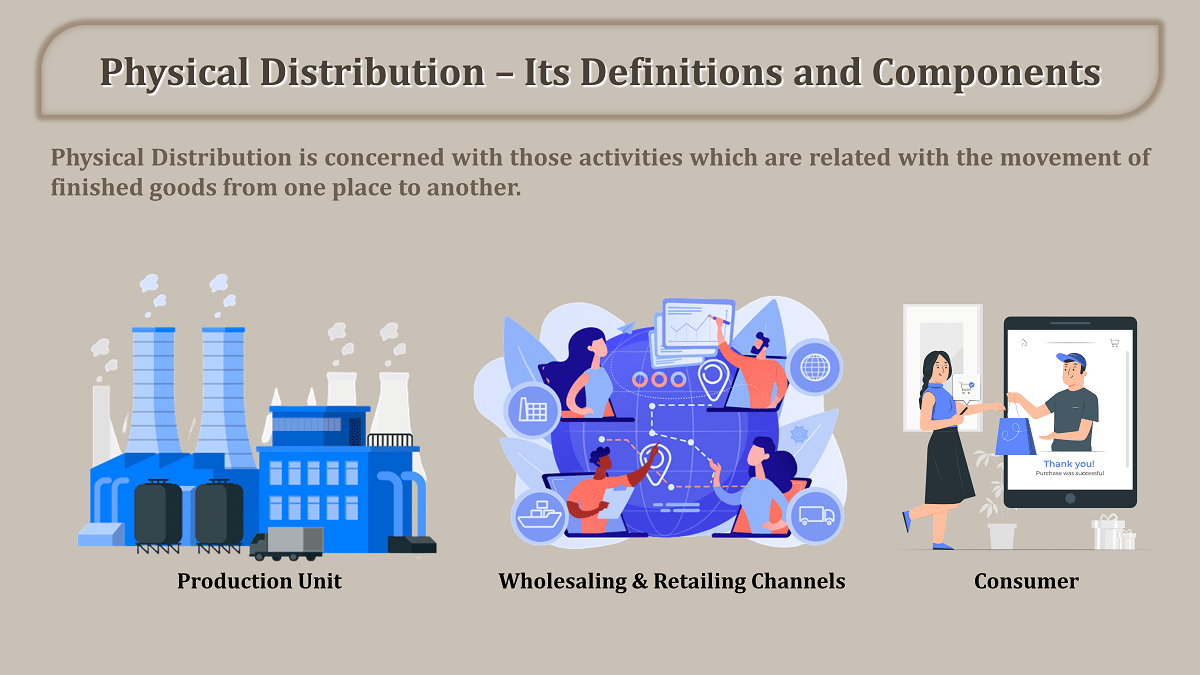
Physical Distribution is concerned with those activities which are related with the movement of finished goods from one place to another. It refers to the wholesale and retail marketing.
Physical Ditribution involves the handling and moving of raw materials and finished products from producer to consumer via an intermediaries. It is also termed as logistics (division of Military Science concerned with procuring, maintaining and transporting equipment and facilities etc.)
In other words, It means the distribution of final goods and services from the production unit to the end user. This distribution takes place by many number of wholesaling and retailing channels, and includes vital decisional areas as warehouse site selection, and warehousing, customer service, inventory control, protective packaging,materials handling, order procession, and transportation.
It creates ‘time’ and ‘place’ utility, that maximises the value of products “by delivering them to the Right Customer at the Right Time and place.The important participants in the distribution are; Producers, Intermediaries and Consumers.
Definitions:
“Physical distribution is the science of Business Logistics where by the proper amount of the right kind of product is made available at the place where demand for its exists. Viewed in this light, physical distribution is key link between manufacturing and demand creation.”
-Wendell M. Smith
“Physical distribution involves the management of the physical flow of products and the establishment and operation of flow system.”
-W.J. Stanton
“Physical distribution involves the actual movement and storage of goods after they are produced and before they are consumed”.
-Cundiff and Still
“Physical distribution is the actual handling and moving of goods within individual firms and along channel system.”
-Mc Carthy
The includes appropriate records of costs for meeting various customer service standards (90%, 95% or 100% within 24 hours), customer satisfaction and quick deliveries in case of urgent orders,etc.
It means to deliver the orders as per customers’ wants/demand or requirements of place and timing.
The order processing tasks relate to following questions:
(a) What a salesman does when he receives an order?
(b) What happens if such an order is received by the order department directly?
It is oncerned with the money invested in inventory/stock, wear and tearetc.
It involves receiving the commodities, storing and loading for delivery to customers as per their requirements.
It's main objective is to make goods and services available at the customers’ place of purchase or at his/her doorstep. In other words, to supply the goods and services at right time and at right place. And we can say that it is only possible through transportation. Rail, Airway, Roadways, Water ways are the main examples of transportation.
There are some items which may be light weighted but few can be heavy, which require proper handling and utmost care. In modern storage facilities, items/good/material can be safely handle by handling equipments (Rail, Airway, Roadways, Water ways)
Business Studies Educator
Mrs. Amanpreet Kaur holds a BBA and MBA degree and has over 10 years of teaching experience in business studies and management concepts.
Physical Distribution is concerned with those activities which are related with the movement of finished goods from one place to another. It refers to the…
Class 11 and Class 12 commerce students, and CA Foundation aspirants, studying Business Studies Class 12.
Yes — this page includes a short interactive quiz so you can check your understanding straight away.