Loading Tutorstips...
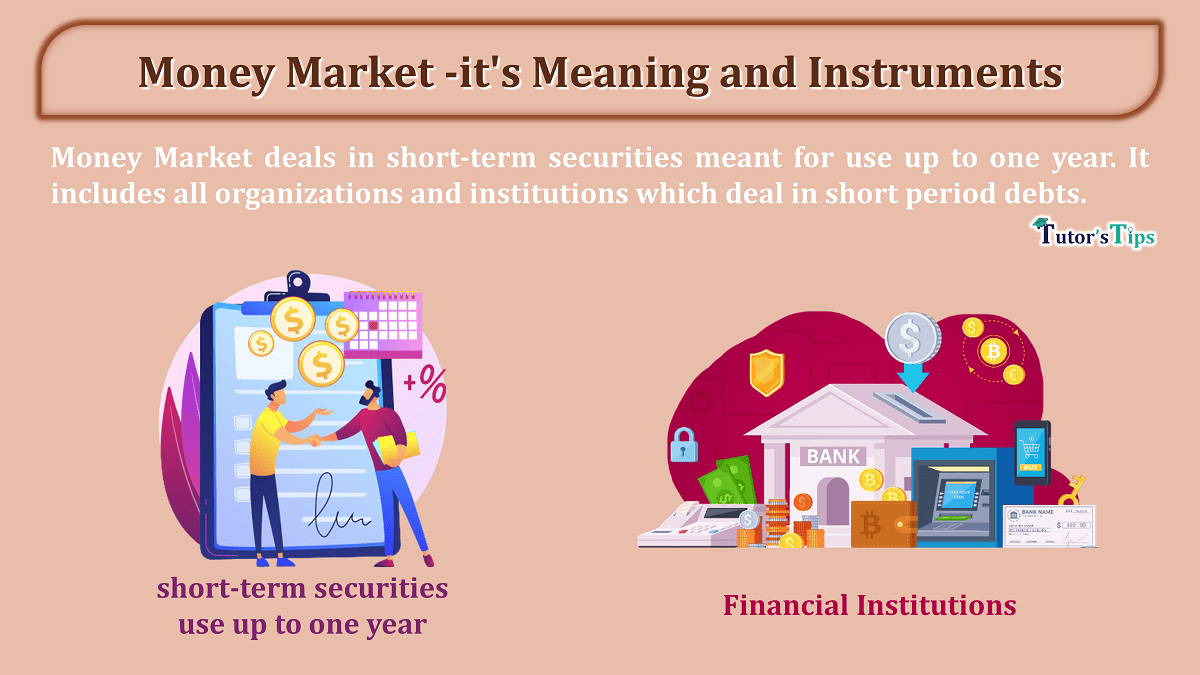
Money Market deals in short-term securities meant for use up to one year. It includes all organizations and institutions which deal in short period debts.
It includes wholesale transactions which take place between financial institutions and companies. It is the pillar of the Global Financial System that deals in short-term funds. And maintains appropriate liquidity in the market. It has no geographical location.
For Example loans, credit card receivables, residential/commercial mortgage loans, and similar financial assets.
The term ‘Money Market’ is used to define a market where short-term financial assets with a maturity of up to one year are traded. The assets are a close substitute for money and support money exchange carried out in the primary and secondary market.
-The Reserve Bank of India
Commercial Papers, Certificates of Deposits, Treasury Bills (T-Bills) Treasury bills or T- Bills and many more are the instruments of Money Market which are explained as follows:
These are short-term borrowing instruments used by the company. The Indian government issues these bills at a discount for 14 days to 364 days.
A company, firm, or person can purchase Treasury bills and are issued in lots of ₹ 25,000 for 14 days & 91 days and ₹ 1,00,000 for 364 days. These instruments are issued at a discount and repaid at par at the time of maturity.
Commercial bills work more like the bill of exchange. Business units issue them to meet their short-term finance requirements. These instruments provide the best liquidity. These can be easily transferred from one person to another.
A certificate of deposit is a negotiable term deposit that is accepted by Commercial Banks. It is usually issued throughout a Promissory Note. CDs can be issued to individuals, corporations, trusts, etc.
Some Business units issue CP’s to meet their short-term working capital requirements. . The period of commercial paper is from 15 days to 1 year.
The Reserve Bank of India makes policies related to the issue of CP’s. Thus, a company requires RBI‘s approval prior to issue a Commercial Paper in the market. Also, these have to be issued at a discount to face value. And the discount rate depends upon the market. The denomination and the size is:
Minimum size – Rs. 5 lakhs
Maximum size – 100% of the issuer’s working capital
Where Scheduled commercial banks lend or borrow on short notice (say a period of 14 days)then it is known as call money. It is concerned to manage day-to-day cash flows. The interest rates are market-driven and thus highly sensitive to demand and supply. Sometimes, the interest rates also fluctuate by a large percentage.
Thanks for reading the topic.
Business Studies Educator
Mrs. Amanpreet Kaur holds a BBA and MBA degree and has over 10 years of teaching experience in business studies and management concepts.
Money Market deals in short-term securities meant for use up to one year. It includes all organizations and institutions which deal in short period debts.…
Class 11 and Class 12 commerce students, and CA Foundation aspirants, studying Business Studies Class 12.
Yes — this page includes a short interactive quiz so you can check your understanding straight away.