Loading Tutorstips...
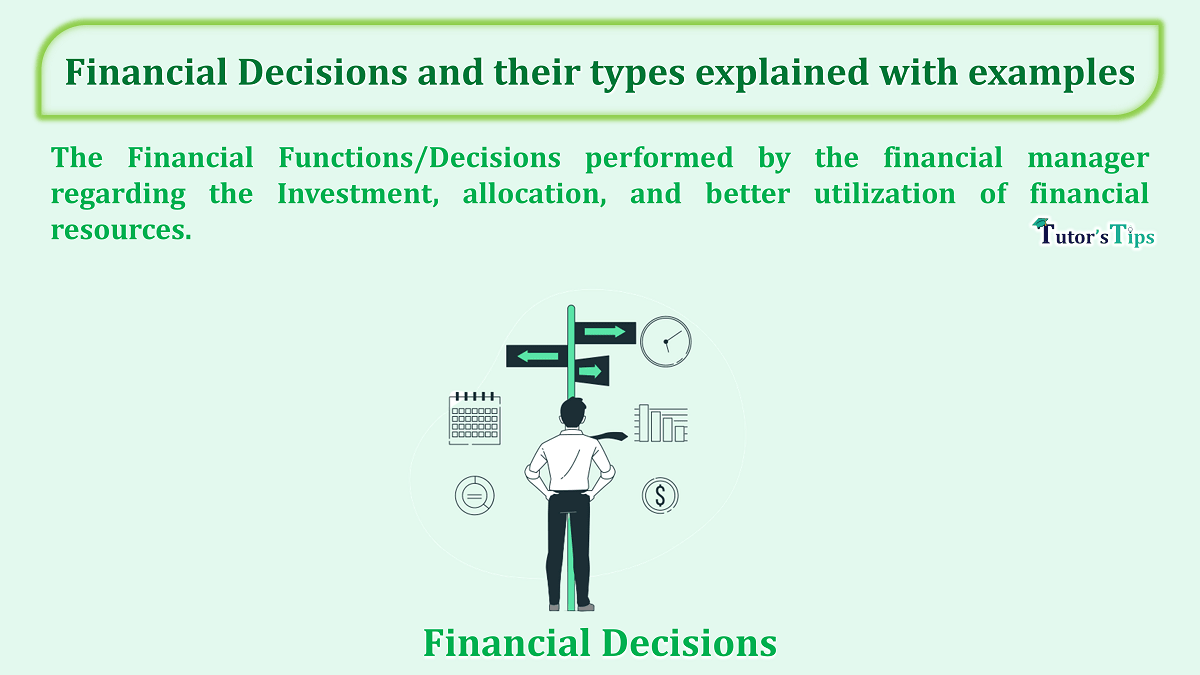
The Financial Functions/Decisions performed by the financial manager regarding the Investment, allocation, and better utilization of financial resources.

These are the monetary functions in which the financial manager takes decisions to invest the money for future purposes. On the other side, it also includes the decisions from which source capital is to be raised. Secondly, appropriate distribution of profit is also included in Financial Decisions.
The types are explained in major three categories which are as follows:
When a financial manager takes the decisions regarding the investment of funds for getting maximum benefits for the firm. It is also known as capital budgeting decisions because, in this, some decisions are related to fixed assets as well as current assets. It is concerned with a large number of funds and also long-term on a permanent basis.
For an example of a long-term capital decision: related to buying Machinery for Production, Purchase Land, and building for expansion. Secondly, Short term capital decisions: related to buying the inventory (Stock), expenses for day-to-day activities.
When a manager decides about the source from where he can raise the capital is called financing decisions. Secondly, it is concerned with borrowing and allocating the funds for the investment. Finance can be raised from the Owner's fund and borrowed funds. If the companies are having a smooth cash flow then borrowed funds preferable.
Owner's Funds include Share capital, Retained earnings.Whereas debentures, loans, bonds are included in borrowed funds. Under this, the finance manager has to focus on the advantages and disadvantages of both sources.
Decisions regarding the distribution of profits of the business among the employees, creditors, debenture holders, shareholders, etc.
The financial manager decides about the Stable dividend policy (The goal of the policy is a balanced and foreseeable dividend payout each year, which is what most investors seek). Constant dividend policy (Under this policy, a company pays a percentage(%) of its earnings as dividends every year) and Residual dividend policy ( a company will prioritize capital expenditures before paying out dividends to its shareholders).
Thanks for reading the topic.
Business Studies Educator
Mrs. Amanpreet Kaur holds a BBA and MBA degree and has over 10 years of teaching experience in business studies and management concepts.
The Financial Functions/Decisions performed by the financial manager regarding the Investment, allocation, and better utilization of financial resources. What…
Class 11 and Class 12 commerce students, and CA Foundation aspirants, studying Business Studies Class 12.
Yes — this page includes a short interactive quiz so you can check your understanding straight away.