Loading Tutorstips...
The Elasticity of demand is an economic term that refers to the sensitivity of demand of a good to changes in other economic variables such as the price of goods, price of related goods and income of consumers, etc. In other words, it is the responsiveness of quantity demanded of a product to changes in one of the variables on which demand depends.
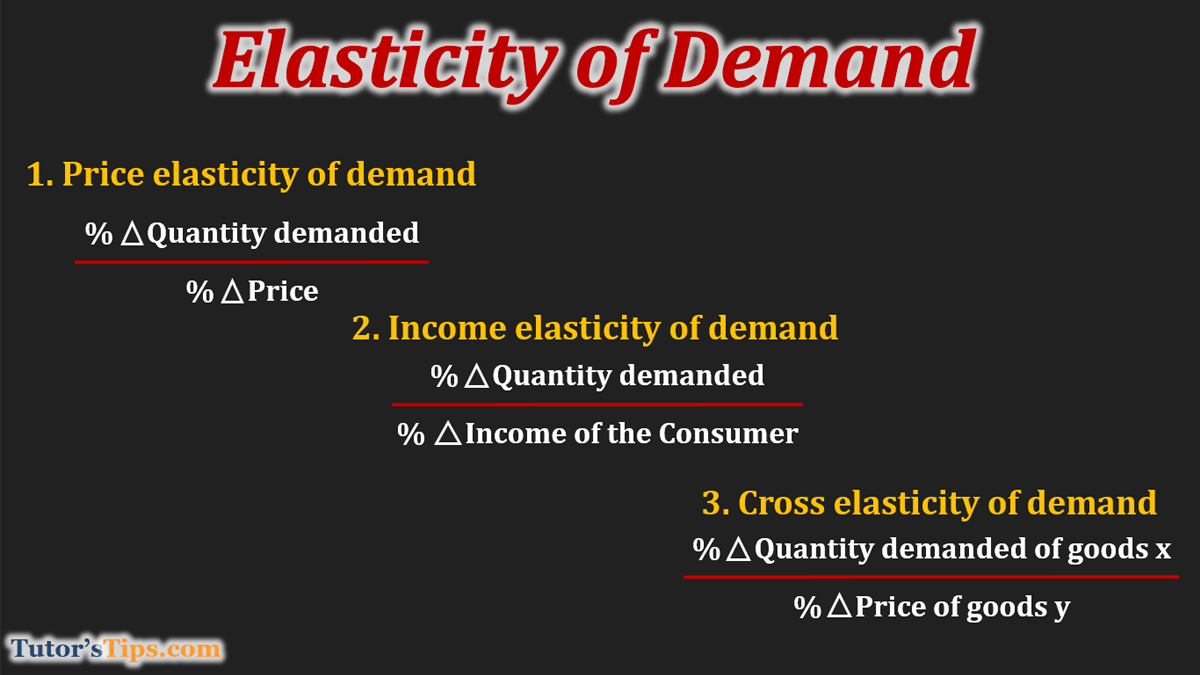
It can be calculated as the percentage change in quantity demanded divided by percentage change in another economic variable.

A higher value for elasticity of demand with respect to any economic variable means that customers are more responsive to changes in that variable.
For example, prices of rice fall from rs.120/kg to Rs 100/kg. Due to this, the quantity demanded in the market increases from 100kg to 120 kgs. It implies the response of demand to decline in the price of rice.
It refers to the degree of responsiveness of quantity demanded with respect to change in the price of that particular commodity, other things remain constant.
it can be calculated as the percentage change in quantity demanded divided by the percentage change in price.

% Δ quantity demanded = percentage change in quantity demanded
% Δ Price = percentage change in price
It refers to the ratio of the percentage of change in quantity demanded and percentage change in income level of consumer. It measures the degree of sensitivity of quantity demanded to change in income.
Hence,
It can be calculated as the percentage change in quantity demanded divided by the percentage change in income of the consumer.

Higher the income elasticity, more sensitive will be the demand with respect to income.
It refers to the sensitivity of demand for one product to the price of another related product. It is the ratio of the percentage change in quantity demanded of goods x and the percentage change in the price of goods y.

Economics Educator
Mrs. Dilgeerjot Kaur holds a B.Com and M.Com degree and has over 9 years of teaching experience in microeconomics, macroeconomics, and business economics.
Elasticity of demand explained simply: meaning, formula, and the 5 types — price, income, cross, perfectly elastic and perfectly inelastic — with real examples.
Class 11 and Class 12 commerce students, and CA Foundation aspirants, studying Economics Class 11.
Yes — this page includes a short interactive quiz so you can check your understanding straight away.