Loading Tutorstips...
The Debenture is treated as the same as a loan. It has a fixed rate of interest which is paid by the firm after every completed year. It has a fixed maturity date.
It is the type of loan or debt instrument which is issued in the market to subscribe to the public. It is not taken from any individual institution. It is issued like equity or preference shares in the market for purchase and sale to the number of subscribers. Like every type of loan, it also has a fixed rate of interest which will be paid by the company to the subscriber after some fixed period of time. The subscriber of it is known as the Debentureholder. Debentureholder will be paid from the preference and equity shareholders in the situation of liquidation of the company.
"Debenture includes debentured stock, bonds, and any other instrument of the company evidencing a debt, whether constituting a charge on the assets of the company or not."
- Section 2(30) of the Companies Act, 2013
"A debenture is a document given by a company as evidence of a debt to the holder usually arising out of a loan and most commonly secured by a charge."
-Topham
Most features are covered by us under this article please check as below:
It is the type of loan because doesn't have any type of share of the ownership of the business. They just get paid the fixed rate of interest on the balance at the end of each financial year.
The Maturity date or the time period after which the Debentures will be repaid decided at the time of the issue of the debentures. All terms regarding repayment of the debenture will be predefined and prefixed.
The rate of interest is fixed throughout its life and it is also fixed before issuing it. They will be paid the interest at the end of each financial year.
Its interest can be charged against the profit of the year. This is one of the best features of it because the company can claim the amount of interest against its profit. So it can save the amount of taxes because the company has to pay tax on profit which left after deduction of interest.
It the best feature of the debentures for the debentureholders because the amount due against it paid first. It means the amount due against it will be paid before any settlement of the equity and preference shareholders.
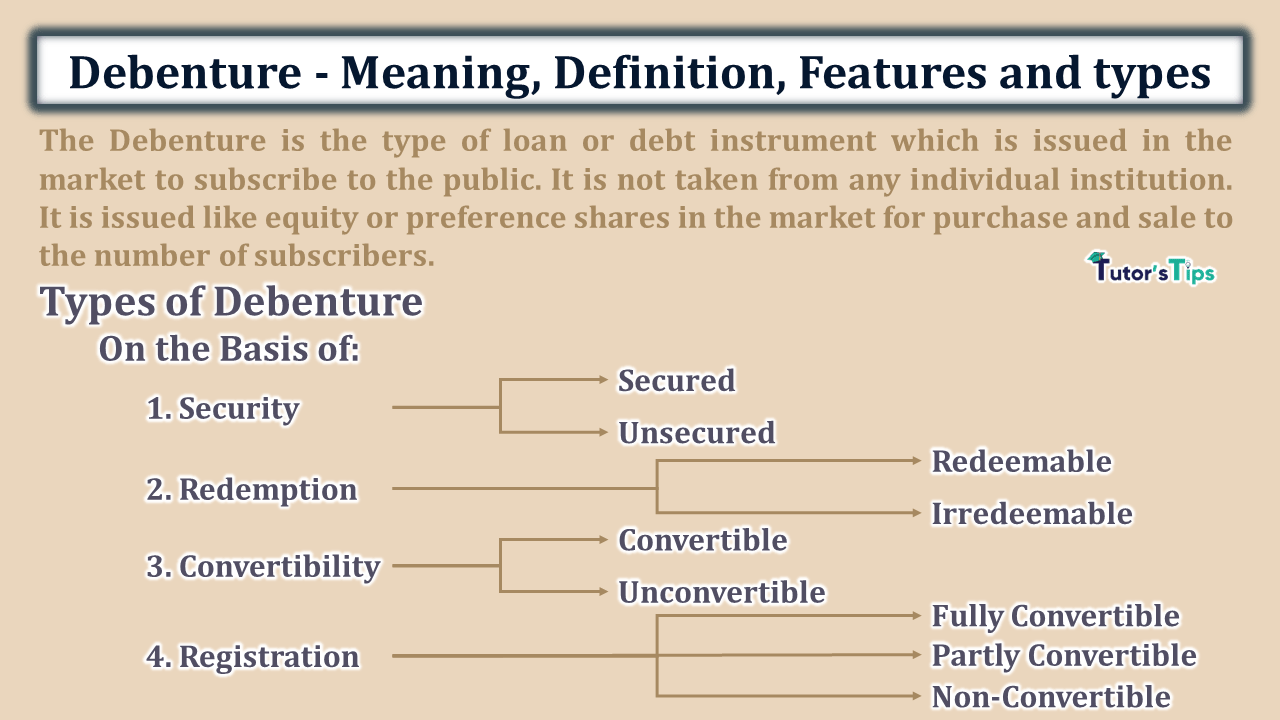
The types of debentures are can be categories on the basis of:
The types of Debentures which are categorized on the basis of Security can be divided into two subcategories. These are shown as below:
Secured Debentures are those which are secured against the fixed asset. That means if the business suffering from loss and about to short down then the specific asset which these are secured the amount realized from that asset will be paid to the secured debentureholders.
Unsecured Debentures are those which are not secured against the fixed assets. That means if the business suffering from loss and about to short down then these types of debentureholder will get the amount in proportionate which is realized from the total assets for the business.
The types of Debentures which are categorized on the basis of Redemption can be divided into two subcategories. These are shown as below:
Redeemable Debentures are those which are redeemed after the fixed maturity date.
Irredeemable Debentures are those which are not redeemed after the fixed maturity date.
The types of Debentures which are categorized on the basis of Redemption can be divided into two subcategories. These are shown as below:
Fully Convertible Debentures are those which are fully converted into equity or preference shares after the maturity date.
Partly Convertible Debentures are those which are partly converted into equity or preference shares after the maturity date.
Non-Convertible Debentures are those which are not converted into equity or preference shares after the maturity date.
Thanks for reading the topic.
p
Accounting & Commerce Educator
Sarbjit Singh holds a B.Com and M.Com degree and has over 12 years of teaching experience in double entry bookkeeping, financial accounting, and business studies.
The Debenture is treated as the same as a loan. It has a fixed rate of interest which is paid by the firm after every completed year. It has a fixed maturity…
Class 11 and Class 12 commerce students, and CA Foundation aspirants, studying Advanced Financial Accounting.
Yes — this page includes a short interactive quiz so you can check your understanding straight away.
17 May 2023
26 May 2023