Loading Tutorstips...
The consumer equilibrium through utility analysis is based on the cardinal concept of utility. The price of commodity, marginal utility of money and the marginal utility of commodity are considered to find the consumer's equilibrium.
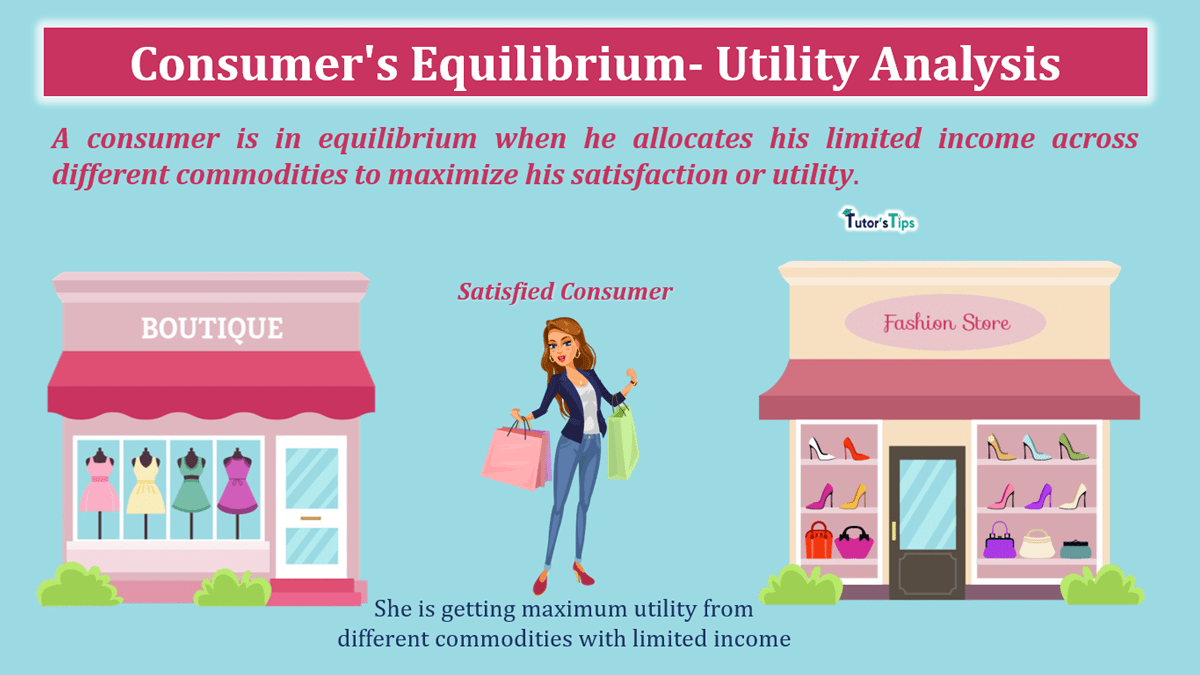
It refers to a situation where a consumer is getting maximum satisfaction by spending his income across different goods. In this situation, the consumer has no tendency to change his expenditure pattern.
In other words, A consumer is in equilibrium when he allocates his limited income across different commodities to maximize his satisfaction or utility. Any change in the allocation of income will lead to a fall in total satisfaction to the consumer.
Subscribe our Youtube Channel
"A consumer is in equilibrium when he regards his actual behaviour as the best possible under the circumstances and feels no urge to change his behaviour as long as circumstances remain unchanged."
Consumer's Equilibrium by utility analysis can be determined under two situations :
In this case, the equilibrium situation of a consumer who gets maximum satisfaction by consuming only one commodity. The consumer buys goods for the price. For each unit of a commodity, he has to make a sacrifice in terms of price. Against this, he gets some utility by consuming the commodity. As the law of diminishing marginal utility, the utility goes on declining as more and more units of a commodity are consumed. On the other hand, this law assumes that the utility of money paid in terms of price remains constant.
A rational consumer will consume the commodity up to a point where the marginal utility derived from the consumption of a commodity is equal to the marginal utility of money i.e. price paid for it. At that point, the consumer will get maximum satisfaction and will be in equilibrium. If he extends consumption beyond this point, the marginal utility from additional units of the commodity will be less than the marginal utility of money. It results in fall in total satisfaction and consumer will not be in equilibrium. Similarly, if the consumer buys one unit less than the equilibrium point, the marginal utility will be more than the marginal utility of money and consumer will deprived of the benefit of this difference in utility. Here also, neither the consumer's satisfaction is maximum nor he will be in equilibrium.
| Units of commodity 'X' | MU of Commodity 'X' | MU of Money(in terms of price) |
| 1 | 80 | 60 |
| 2 | 70 | 60 |
| 3 | 60 | 60 |
| 4 | 50 | 60 |
| 5 | 40 | 60 |
Suppose the price of commodity 'X' is Rs50 per unit which in terms of marginal utility is taken as 60 units and considered as constant. When the consumer buys 3 units of commodity 'X', then marginal utility gained from its consumption and marginal utility sacrificed in terms of its price are equal to each other. Here, the consumer will be in equilibrium as Marginal utility of money is equal to price. Beyond this point, the increase in units purchased results in the less marginal utility of commodity than MU of money and he will not attain maximum satisfaction and will not be in equilibrium. Similarly, if he consumes less than 3 units of the commodity, the marginal utility of commodity 'X' will be more than MU of money. At this situation also, the consumer will not be in equilibrium.
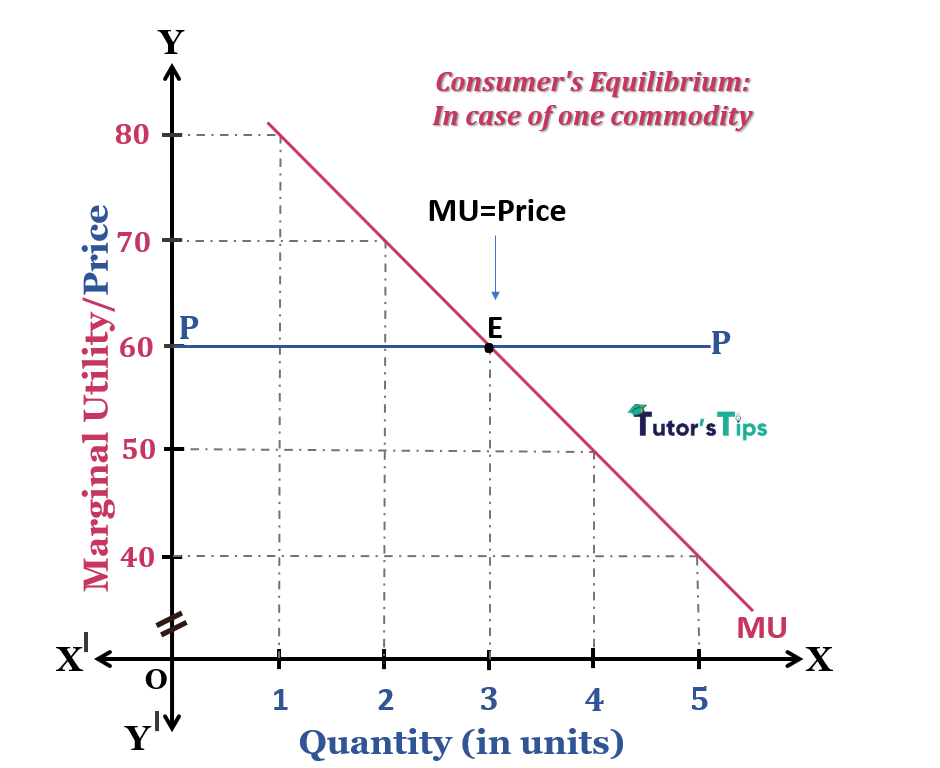
In fig, X-axis shows the quantity of commodity X and Y-axis shows the marginal utility. MU is the marginal utility curve of commodity X and PP is the marginal utility sacrificed in terms of price for the commodity X. The consumer is in equilibrium at point E where marginal utility of 3rd unit of commodity X equals to the price.
In this case, the equilibrium situation of a consumer who gets maximum satisfaction by consuming a combination of commodities. He has fixed income to spend on different goods and gets maximize utility. His preference will be the commodity having the highest MU against the same price. He has to compare the MU of different commodities in return for each unit of money.
As per the law of diminishing marginal utility, the utility goes on decreasing with the increase in consumption of a commodity. Thus, the consumer stops the purchasing when MU of one commodity becomes less than MU of the other one and will shift to another commodity. In this way, the consumer starts buying substitute goods having more marginal utility. Finally, he arrives at a situation where the last unit of money spent on different commodities yields the same marginal utility. This situation is known as a position of equilibrium. Here, he gets maximum satisfaction and has no desire to switch to any other commodity.
In the case of one commodity say 'X', equilibrium arrives when :
| MUX | = | MUM |
| PX |
In case of another commodity say 'Y', equilibrium arrives when :
| MUY | = | MUM |
| PY |
A consumer is in equilibrium when he buys both commodities and gets maximum satisfaction against the price paid for it. In other words, the consumer is in equilibrium when he gets the same MU of money by consuming different commodities.
| MUX | = | MUY | = | MUM |
| PX | PY |
| Money Spent (in units) | MU of Commodity 'X' | MU of Commodity 'Y' |
| 1st | 74 | 65 |
| 2nd | 66 | 60 |
| 3rd | 60 | 55 |
| 4th | 52 | 50 |
| 5th | 48 | 45 |
Suppose, a customer has 5 units of money to spend across commodity 'X' and 'Y'.He will spend 1st unit of money on commodity X and gets 74 utils of utility, by spending 2nd unit of money gets 66 utils of utility. Then he will spend the 3rd unit of money on commodity 'Y' and gets 65 utils of utility. Similarly, the consumer gets the same utility of 60 utils by spending 4th and 5th unit of money on commodity 'X' and 'Y'. Thus total utility is maximised(74+66+65+60+60=325). No other combination of X and Y will offer higher than 325 utils of utility to the consumer by spending 5 units of money on X and Y.
Graphical Representation :
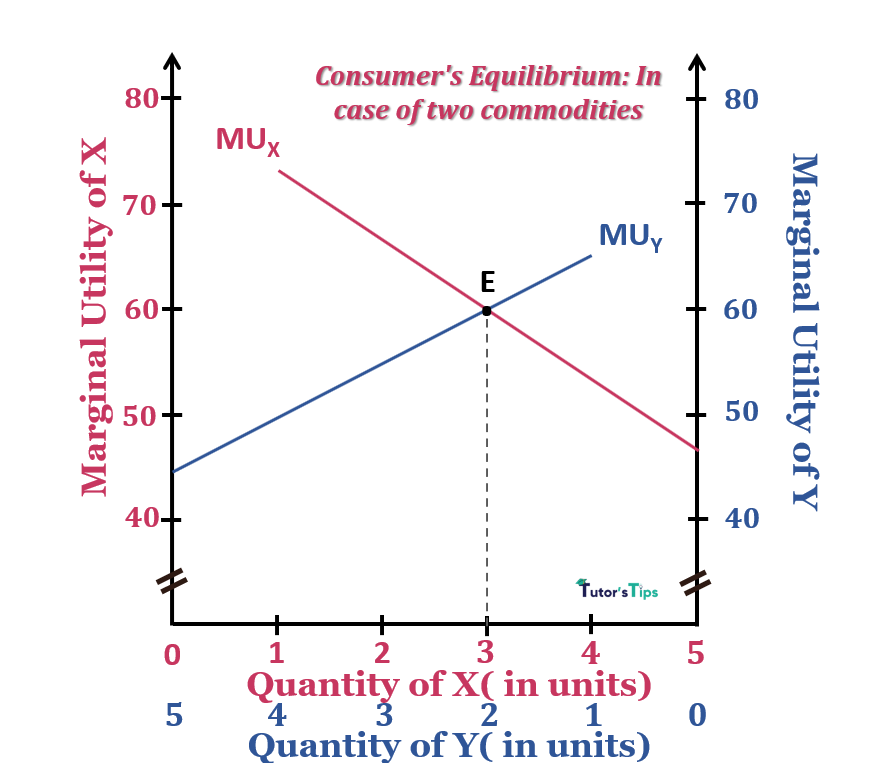
In fig, the quantities of commodities X and Y are shown on X-axis and Y-axis shows the marginal utility of X and Y. MUX is the marginal utility curve of commodity X and MUY is the marginal utility curve of commodity Y. The consumer is at equilibrium point E where he consumes 3 units of commodity X and 2 units of commodity Y and the marginal utility of both commodities are equal.
Economics Educator
Mrs. Dilgeerjot Kaur holds a B.Com and M.Com degree and has over 9 years of teaching experience in microeconomics, macroeconomics, and business economics.
The consumer equilibrium through utility analysis is based on the cardinal concept of utility. The price of commodity, marginal utility of money and the…
Class 11 and Class 12 commerce students, and CA Foundation aspirants, studying Economics Class 11.
Yes — this page includes a short interactive quiz so you can check your understanding straight away.