Loading Tutorstips...
Question 24 Chapter 4 of +2-B
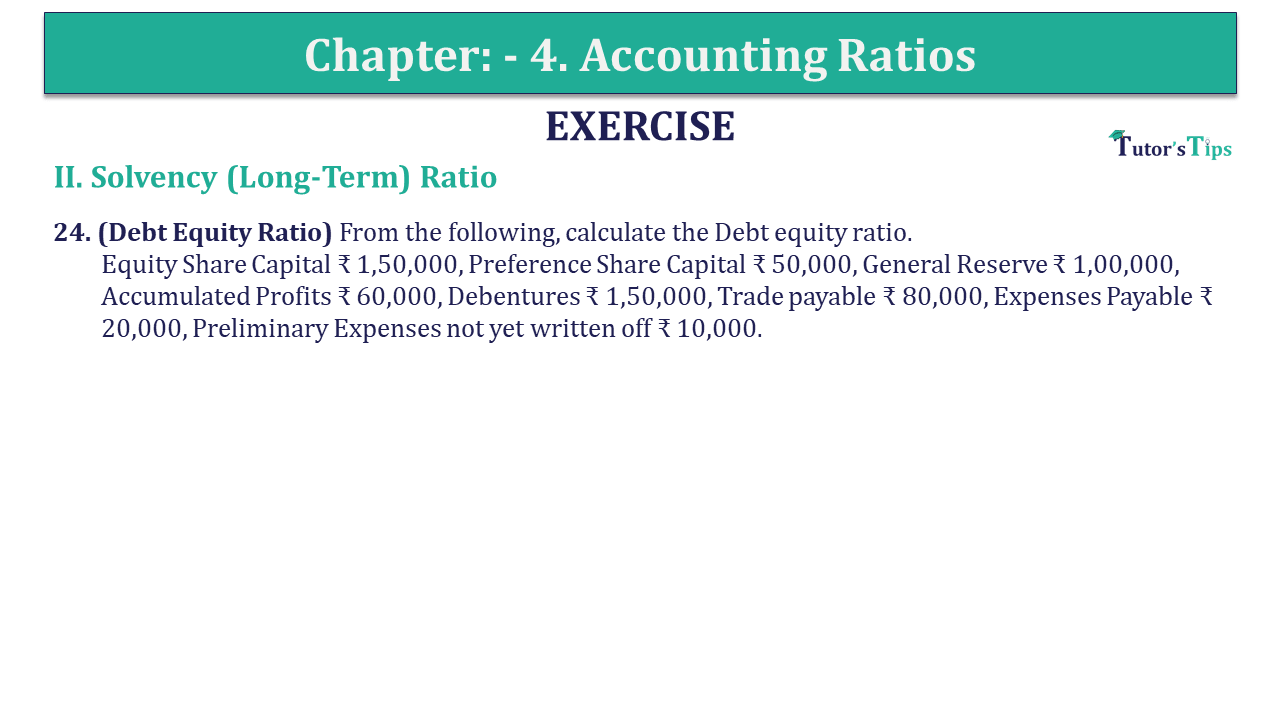
II. Solvency (Long-Term) Ratio
24. (Debt Equity Ratio) From the following, calculate the Debt equity ratio.
Equity Share Capital ₹ 1,50,000, Preference Share Capital ₹ 50,000, General Reserve ₹ 1,00,000, Accumulated Profits ₹ 60,000, Debentures ₹ 1,50,000, Trade payable ₹ 80,000, Expenses Payable ₹ 20,000, Preliminary Expenses not yet written off ₹ 10,000.
| Debt Equity Ratio | = | Debt |
| Shareholders Funds |
| Debt | = | Dentures |
| = | ₹ 1,50,000 | |
| Shareholders Funds | = | Equity Share Capital + Preference Share Capital + General Reserve + Accumulated Profits - Preliminary Expenses |
| = | ₹ 1,50,000 + ₹ 50,000 + ₹ 1,00,000 + ₹ 60,000 - ₹ 10,000 | |
| = | ₹ 3,50,000 |
| Debt Equity Ratio | = | ₹ 1,50,000 |
| ₹ 3,50,000 | ||
| = | 3 : 7 |
https://tutorstips.com/what-are-liquidity-ratios-formulas-and-examples/
Comment if you have any question.
Accounting & Commerce Educator
Sarbjit Singh holds a B.Com and M.Com degree and has over 12 years of teaching experience in double entry bookkeeping, financial accounting, and business studies.
This guide covers "Question 24 Chapter 4 of +2-B - USHA Publication 12 Class", focusing on key definitions, step-by-step concepts, applications, and revision guidelines relevant to USHA Publication Part 2 volume I.
It is primarily curated for Class 11 and Class 12 high school commerce, accounting, and economics students, as well as aspirants preparing for board exams or CA Foundation.
You can take our custom-built interactive practice quiz directly on this page to test your understanding of "Question 24 Chapter 4 of +2-B - USHA Publication 12 Class" instantly.